
A French toast casserole that serves six, takes 33 minutes, uses a cashew custard that’s genuinely silky and rich, and gets topped with fresh summer blueberries and cinnamon sugar before hitting a hot oven this is the brunch recipe that makes you the most popular person at any summer gathering. Easy Vegan Blueberry French Toast Casserole removes every complication from traditional French toast while producing something that looks and tastes significantly more impressive. No standing over a skillet flipping individual slices. Just a beautiful baking dish of golden, blueberry-topped, custard-soaked bread that comes out of the oven ready to serve to everyone simultaneously.
I make this specifically for summer weekends when the whole family or friend group shows up and I want something that feeds everyone without me being stuck at the stove while everyone else relaxes. The cashew custard was the discovery that changed how I think about vegan French toast entirely it’s genuinely better than egg-based custard in several specific ways. Let me explain why.

My Recipe Timing and Serving Details
Here’s your complete planning overview:
| Detail | Info |
| Cashew Soak Time | 15 minutes (hot water soak) |
| Prep Time | 15 minutes |
| Cook Time | 18 minutes |
| Total Time | 33 minutes |
| Servings | 6 servings |
| Serving Size | 1 of 6 portions |
| Calories Per Serving | 194 kcal |
| Course | Breakfast / Brunch |
| Diet | 100% Vegan |
33 minutes total from start to table for a casserole that serves 6 people simultaneously. At 194 calories per serving, this is a genuinely light, satisfying brunch option that leaves room for fresh fruit alongside without anyone feeling guilty about seconds. The make-ahead option (detailed below) makes this the ideal recipe for holiday mornings or entertaining assemble the night before, bake when ready.
The Cashew Custard Why It’s Better Than Egg Custard
The heart of this entire casserole is the blended cashew custard and it deserves explanation before we get to the cooking instructions, because understanding why it works helps you appreciate what you’re making.
Traditional French toast custard uses eggs and dairy milk. The eggs provide binding protein and fat, the milk provides liquid volume, and together they create a coating that sets when heated to produce that characteristic custard quality.
Blended cashew custard replicates this through entirely different chemistry. Raw cashews, when soaked and blended with water, create a naturally creamy, slightly thick liquid that’s high in fat and has a neutral, slightly sweet flavor. The small amount of flour in this recipe acts as a mild thickener that helps the custard set during baking. The almond and vanilla extracts provide the aromatic warmth.
The key difference from egg custard. cashew custard is smoother. Properly blended cashew custard has a silkiness that egg-based custard doesn’t quite achieve it coats bread more evenly and produces a more uniform custard layer throughout the casserole. FYI once you make a casserole with this custard, the egg version starts to seem unnecessarily complex.
My Full Ingredient List
A clean, deliberate ingredient list for a casserole that genuinely impresses:
For the Cashew Custard:
- ½ cup raw cashews , soaked in hot water for 15 minutes
- 1 cup water
- 1 teaspoon flour , or cornstarch/tapioca starch for gluten-free
- ¼ teaspoon almond extract
- ½ teaspoon vanilla extract
- 3 tablespoons sugar
For the Topping:
- 2 teaspoons brown sugar
- 1 teaspoon cinnamon
- 1 cup blueberries (or other berries)
Other:
- 6–8 slices bakery bread, ciabatta, or French bread , not too soft
- 2–3 teaspoons neutral oil , for the baking dish
For Serving:
- Maple syrup
- Fresh fruit alongside
The almond extract alongside vanilla is a combination that sounds subtle but creates something genuinely distinctive. Almond extract adds a warm, slightly floral character that pairs beautifully with both the bread’s toasted edges and the blueberries’ acidity. Start with exactly ¼ teaspoon almond extract is potent and the quantity in this recipe is precisely calibrated. More would overpower everything else.

Equipment You’ll Need For
This recipe requires specific equipment choices that affect the result:
The Baking Dish Stoneware or Ceramic Only
The recipe specifically calls for a stoneware or ceramic baking dish approximately 10×13 inches in size. This specification is genuinely important:
Stoneware and ceramic distribute heat slowly and evenly, which prevents the bottom of the casserole from cooking too fast while the top is still raw. They also retain heat after removal from the oven, which continues gently cooking the custard as the casserole rests.
Glass baking dishes work adequately but conduct heat differently the bottom can become too hot and over-brown while the custard is still setting.
Metal baking pans are the worst choice here they heat too aggressively and produce a bottom layer that’s overcooked by the time the top finishes. The casserole needs gentle, even heat. IMO, investing in a good stoneware baking dish is worth it for this recipe alone.
The Blender High-Powered for Smooth Custard
- High-powered blender – absolutely essential for achieving the completely smooth custard the recipe requires. A Vitamix, Blendtec, or similar high-powered machine blends soaked cashews to absolute smoothness in 1–2 minutes. A standard blender requires the specific technique the recipe describes: blend one minute, rest, blend again, repeat 2–3 times.
The goal is a custard with zero grittiness not even a slight grainy texture. The cashews need to break down completely into a smooth emulsion. If you run your finger through the custard and feel any texture at all, blend again. Gritty custard produces a casserole with a textural problem that undermines the whole dish.
Supporting Equipment For
- Small bowl – for the cinnamon sugar topping mixture
- Pastry brush – for oiling the baking dish and brushing additional custard over the bread before baking
- Wide shallow bowl or dish – for dipping the bread slices into the custard
Step-by-Step Instructions
Step 1 – Soak the Cashews
Cover the ½ cup of raw cashews with hot (not boiling) water and let them soak for 15 minutes. This softening is what allows the blender to break them down completely into smooth custard rather than leaving gritty cashew particles. Don’t skip or significantly shorten the soak time under-soaked cashews don’t blend smoothly regardless of how powerful your blender is.
While the cashews soak, preheat your oven to 425°F (220°C) and prepare the topping by mixing 2 teaspoons brown sugar and 1 teaspoon cinnamon in a small bowl. Set both aside.
Step 2 – Make the Cashew Custard
Drain the soaked cashews. Add them to the blender along with the 1 cup of water, flour, almond extract, vanilla extract, and sugar. Blend on high for 1 full minute.
Stop the blender and let the mixture rest for 2–3 minutes this allows the cashew particles that the blade broke up to hydrate further from residual heat.
Blend again for 1 minute. Rest again. Repeat this process 2–3 times total until the custard is completely smooth with no grittiness whatsoever. The finished custard should look like cream pale, slightly thick, and perfectly uniform.
Testing for smoothness- Rub a small amount between your fingers. No grittiness = the custard is ready. Any texture at all = blend again.
Step 3 – Prepare the Baking Dish and Bread
Brush your stoneware or ceramic baking dish with 2–3 teaspoons of neutral oil coat the bottom and sides thoroughly.
Pour approximately two-thirds of the custard into the baking dish and spread it across the bottom. The remaining third goes in a separate bowl for dipping.
Dip each bread slice into the custard in the bowl, turning to coat both sides and holding briefly to allow absorption. Sturdier bread absorbs faster; softer bread needs more time and may need a few minutes of soaking. The recipe notes this specifically adjust your soaking time based on your bread’s density.
Arrange the custard-coated slices in the baking dish they should touch each other but not overlap significantly. Pack them in snugly.
Step 4 – Top and Bake
Brush the remaining custard from the bowl over the tops of all the bread slices. Sprinkle the cinnamon sugar mixture evenly across the surface. Add the 1 cup of blueberries distributed across the top press each one very slightly into the bread surface.
Place in the preheated 425°F oven and bake for 15–18 minutes until the edges of the custard and bread turn golden. The exact time depends on your oven, bread thickness, and baking dish thickness start checking at 15 minutes.
Step 5 – Remove and Serve Immediately
This is the critical step the recipe specifically emphasizes– Remove the individual French toast slices from the baking dish while they’re still hot. The custard firms as it cools and will stick the bread to the dish as the temperature drops. Use a spatula to carefully lift each piece onto a serving plate or platter while everything is still warm.
If custard remains in the dish, pour it into a small saucepan and heat over medium heat while whisking until it thickens to a drizzling sauce consistency. Pour this over the plated casserole.
Drizzle with maple syrup and serve with fresh fruit.

The Bread Choice Why It Makes or Breaks the Casserole
Not all bread works equally well in a baked French toast casserole, and the recipe’s guidance is specific for good reasons:
Best Bread Options
Ciabatta – the recipe’s top recommendation, and it’s genuinely the ideal choice. Ciabatta has a chewy, sturdy structure with an open crumb that absorbs custard deeply while maintaining structural integrity through baking. Its slight crispiness at the edges caramelizes beautifully at 425°F. Use ciabatta whenever possible.
French bread or baguette – similar structural integrity to ciabatta. The denser crumb absorbs custard more slowly, so allow longer soaking time. Produces a slightly drier interior and crispier exterior than ciabatta.
Artisan bakery white bread – works well if it’s a sturdy, crusty variety rather than a soft sandwich style. Day-old artisan bread is specifically better than fresh it has the right moisture level for custard absorption without becoming waterlogged.
What Doesn’t Work
Soft sandwich bread – collapses when custard-soaked and produces a mushy casserole without distinct toast slices. Avoid entirely.
Very thin slices – the bread needs thickness (at least ¾ inch) to provide structural integrity through the soaking and baking process.
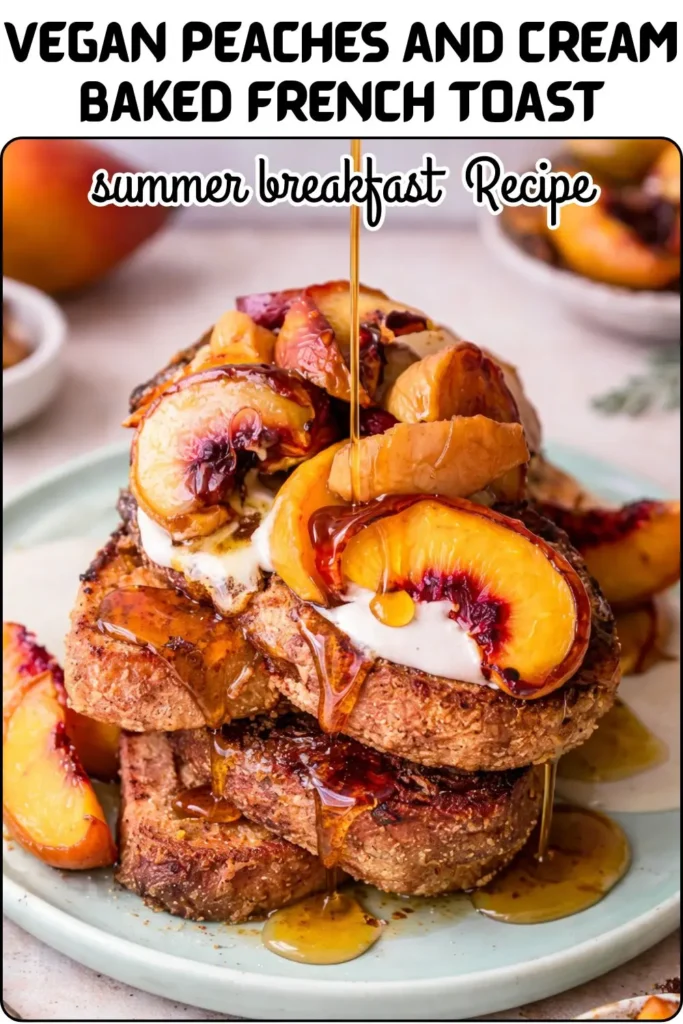
Try It Next recipe
Vegan Peaches and Cream Baked French Toast
The Make-Ahead Option Perfect for Entertaining
The recipe specifically offers a make-ahead version that’s genuinely excellent for holiday mornings, summer brunch entertaining, or any situation where you want the casserole ready to bake rather than requiring 33 minutes of morning prep:
The night before:
- Assemble the casserole exactly as described oil the dish, add custard, dip bread, arrange, brush with remaining custard
- Add the blueberries but hold the cinnamon sugar until baking day
- Cover tightly with foil
- Refrigerate overnight
In the morning:
- Remove from refrigerator 15 minutes before baking to reduce temperature shock
- Remove foil
- Brush on additional custard (the bread absorbs liquid overnight fresh custard restores the right moisture level)
- Sprinkle cinnamon sugar
- Bake as directed at 425°F for 15–18 minutes
The overnight soak actually produces an even better result than same-day baking the bread absorbs the custard more completely and the flavor deepens. Make-ahead is genuinely recommended when you have the planning capacity.
Nut-Free and Gluten-Free Variations
The recipe provides specific substitutions for two common dietary needs:
Nut-Free Version
Replace the cashews with a combination of 3 tablespoons hemp seeds and 3 tablespoons silken tofu. Hemp seeds provide fat and creaminess, silken tofu provides protein and binding. Blend exactly as you would the cashew custard the mixture should be completely smooth. The flavor is slightly different from cashew custard but still excellent and the texture works well for the casserole.
Gluten-Free Version
Two changes:
- Replace the flour in the custard with cornstarch or tapioca starch same quantity (1 teaspoon)
- Use gluten-free bread ciabatta-style gluten-free bread from brands like Schar or Canyon Bakehouse work best
The custard thickens slightly differently with starch versus flour but produces a good result. The key is still getting the custard completely smooth before using it.
Nutrition Information Per Serving
At 194 calories per serving, this casserole is impressively lean:
| Nutrient | Per Serving (1 of 6) |
| Calories | 194 kcal |
| Carbohydrates | 28g |
| Protein | 5g |
| Fat | 7g |
| Saturated Fat | 1g |
| Fiber | 2g |
| Sugar | 12g |
| Sodium | 136mg |
| Iron | 2mg |
The fat content reflects the cashews healthy, whole-food plant fat that contributes to the custard’s richness. At 194 calories per serving before maple syrup, this casserole is one of the most calorie-efficient impressive brunch recipes possible. Two servings with a side of fresh fruit creates a complete brunch at approximately 430 calories genuinely satisfying.
Storage and Reheating
- Refrigerator- Store leftovers in an airtight container for up to 3 days. Reheat in a 350°F oven for 8–10 minutes to restore the slightly crispy exterior.
- Microwave reheating- Works for convenience but produces softer results without the crispy edges.
- The custard- If you have leftover custard, store in a sealed container for up to 3 days and use as a sauce, drizzle over pancakes, or incorporate into another French toast batch.
My Final Thoughts Make This Casserole and Become the Brunch Host Everyone Wants
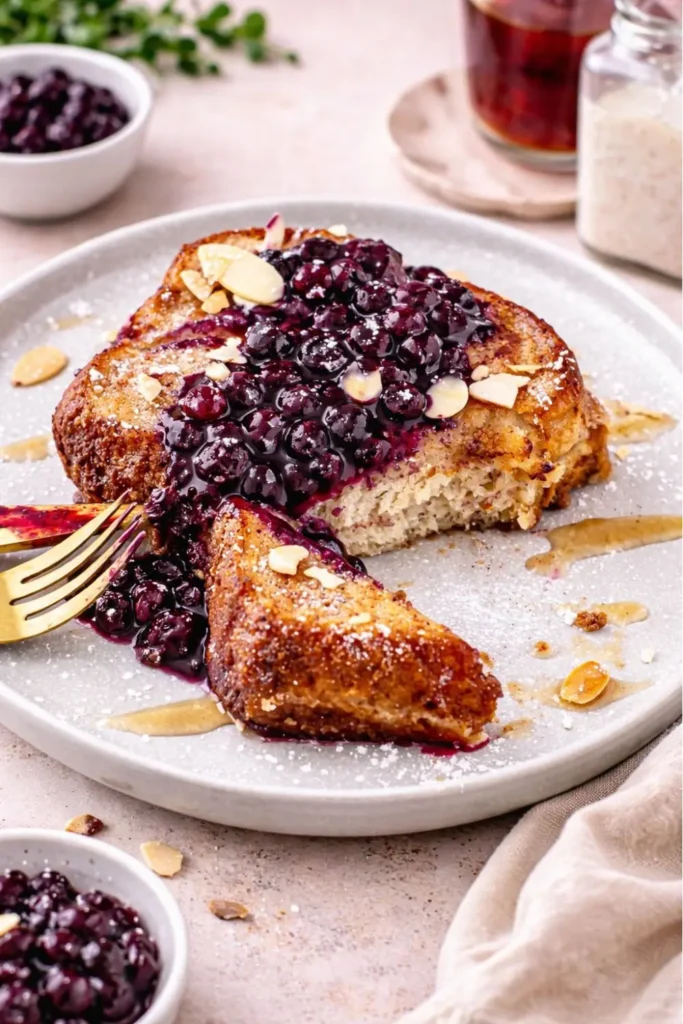
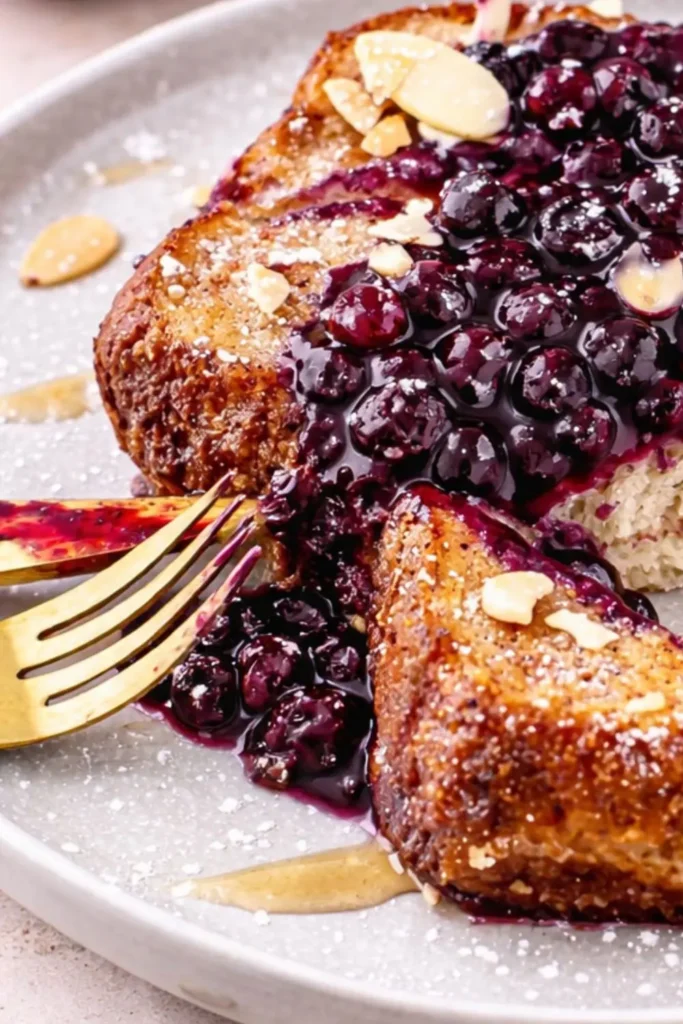
Easy Vegan Blueberry French Toast Casserole is the brunch recipe that proves plant-based cooking produces genuinely impressive food for groups. Smooth cashew custard, summer blueberries, cinnamon sugar topping, and beautiful bakery bread baked together in 18 minutes serving six people simultaneously from a single dish at 194 calories per serving.
The make-ahead option makes it perfect for entertaining. The cashew custard technique makes it genuinely better than egg-based alternatives. The blueberries make it look beautiful enough to photograph before eating.
Soak the cashews tonight. Assemble in the morning. Bake for 18 minutes. Accept the compliments that follow.

Easy Vegan Blueberry French Toast Casserole
Ingredients
Equipment
Method
- Step 1 – Soak the Cashews
- Cover the ½ cup of raw cashews with hot (not boiling) water and let them soak for 15 minutes. This softening is what allows the blender to break them down completely into smooth custard rather than leaving gritty cashew particles. Don’t skip or significantly shorten the soak time under-soaked cashews don’t blend smoothly regardless of how powerful your blender is.
- While the cashews soak, preheat your oven to 425°F (220°C) and prepare the topping by mixing 2 teaspoons brown sugar and 1 teaspoon cinnamon in a small bowl. Set both aside.
- Step 2 – Make the Cashew Custard
- Drain the soaked cashews. Add them to the blender along with the 1 cup of water, flour, almond extract, vanilla extract, and sugar. Blend on high for 1 full minute.
- Stop the blender and let the mixture rest for 2–3 minutes this allows the cashew particles that the blade broke up to hydrate further from residual heat.
- Blend again for 1 minute. Rest again. Repeat this process 2–3 times total until the custard is completely smooth with no grittiness whatsoever. The finished custard should look like cream pale, slightly thick, and perfectly uniform.
- Testing for smoothness- Rub a small amount between your fingers. No grittiness = the custard is ready. Any texture at all = blend again.
- Step 3 – Prepare the Baking Dish and Bread
- Brush your stoneware or ceramic baking dish with 2–3 teaspoons of neutral oil coat the bottom and sides thoroughly.
- Pour approximately two-thirds of the custard into the baking dish and spread it across the bottom. The remaining third goes in a separate bowl for dipping.
- Dip each bread slice into the custard in the bowl, turning to coat both sides and holding briefly to allow absorption. Sturdier bread absorbs faster; softer bread needs more time and may need a few minutes of soaking. The recipe notes this specifically adjust your soaking time based on your bread’s density.
- Arrange the custard-coated slices in the baking dish they should touch each other but not overlap significantly. Pack them in snugly.
- Step 4 – Top and Bake
- Brush the remaining custard from the bowl over the tops of all the bread slices. Sprinkle the cinnamon sugar mixture evenly across the surface. Add the 1 cup of blueberries distributed across the top press each one very slightly into the bread surface.
- Place in the preheated 425°F oven and bake for 15–18 minutes until the edges of the custard and bread turn golden. The exact time depends on your oven, bread thickness, and baking dish thickness start checking at 15 minutes.
- Step 5 – Remove and Serve Immediately
- This is the critical step the recipe specifically emphasizes- Remove the individual French toast slices from the baking dish while they’re still hot. The custard firms as it cools and will stick the bread to the dish as the temperature drops. Use a spatula to carefully lift each piece onto a serving plate or platter while everything is still warm.
- If custard remains in the dish, pour it into a small saucepan and heat over medium heat while whisking until it thickens to a drizzling sauce consistency. Pour this over the plated casserole.
- Drizzle with maple syrup and serve with fresh fruit.
Notes
Nutrition Information Per Serving
At 194 calories per serving, this casserole is impressively lean:| Nutrient | Per Serving (1 of 6) |
| Calories | 194 kcal |
| Carbohydrates | 28g |
| Protein | 5g |
| Fat | 7g |
| Saturated Fat | 1g |
| Fiber | 2g |
| Sugar | 12g |
| Sodium | 136mg |
| Iron | 2mg |

Hi — I’m Rachel. I’m a wife, a mom, and a home cook who believes that food should bring comfort, joy, and compassion to the table. I live with my family — two hungry little foodies who are my most honest recipe testers — and together we’ve built a kitchen culture that’s all about good food that happens to be 100% vegan. I started this blog because I wanted a place to share the recipes that keep our days moving, the dishes that make weeknights feel a little easier, and the meals that become our little family traditions.