
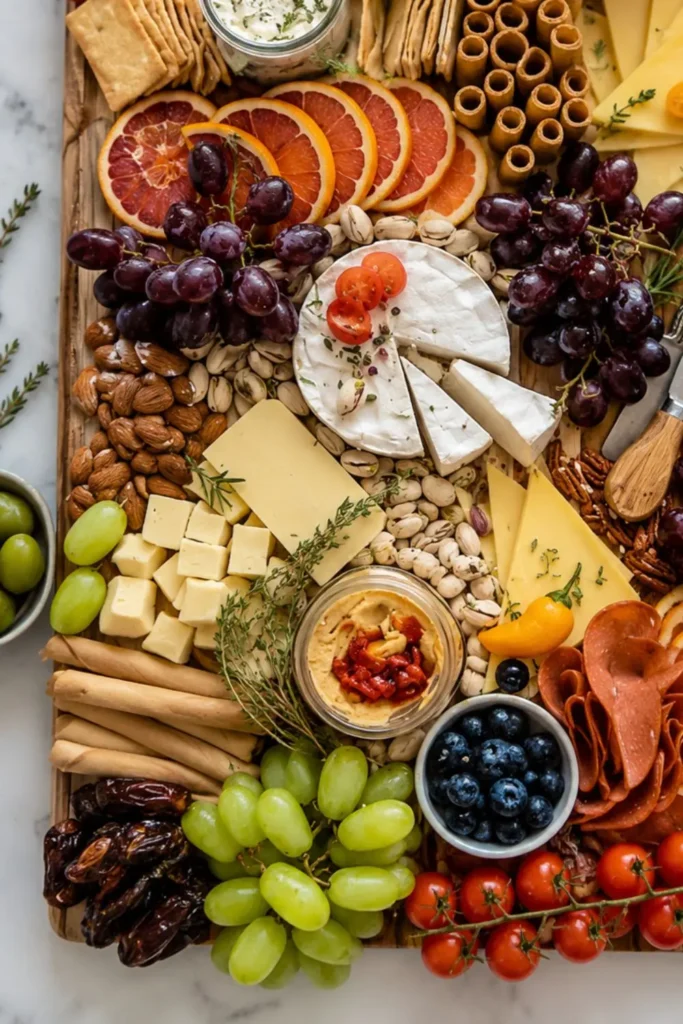
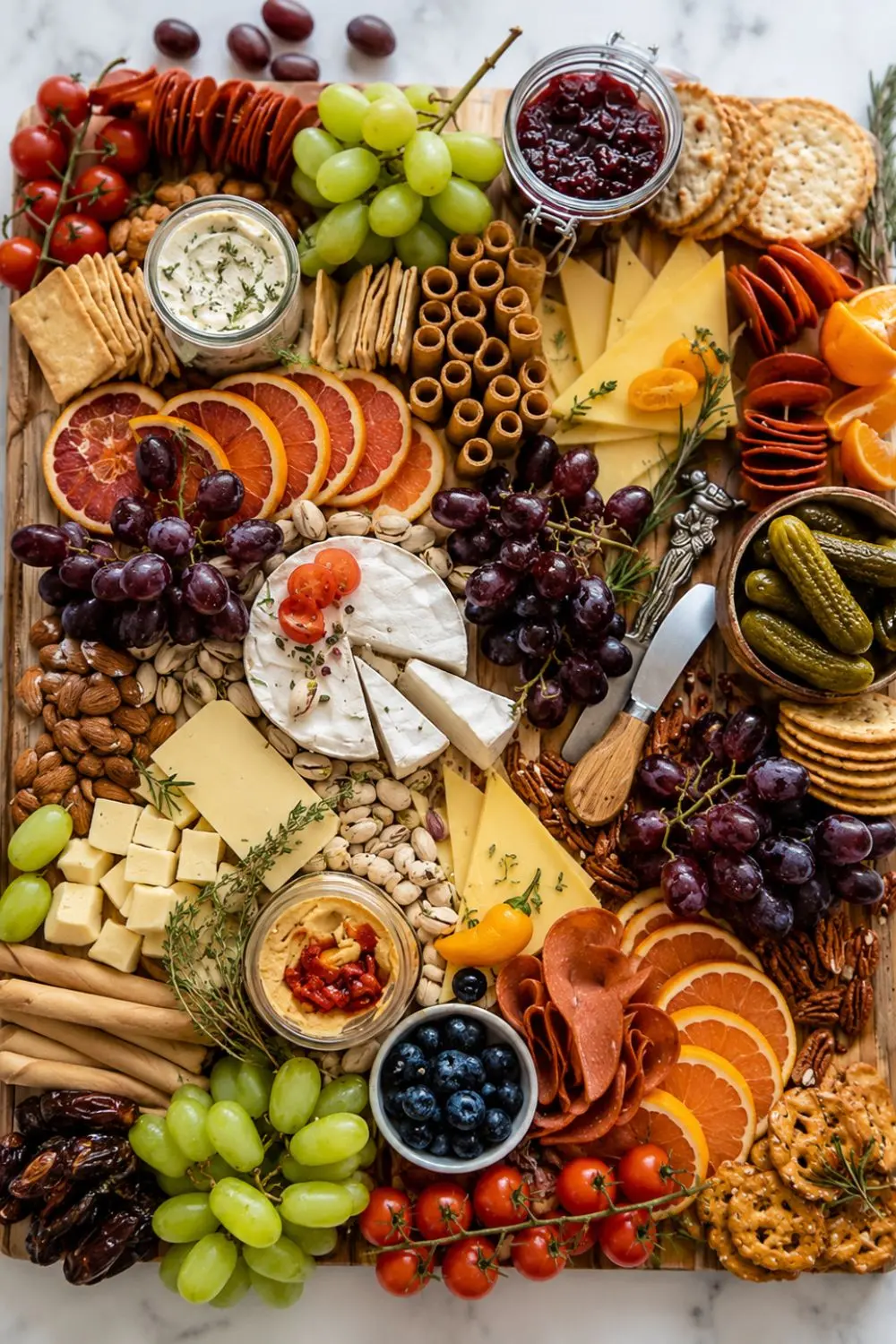
A beautifully built vegan charcuterie board is genuinely one of the most impressive things you can put on a table and here’s the part that surprises most people: it takes 30 minutes, requires zero cooking, and produces the single most photographed item at any gathering you bring it to. How to Build a Stunning Vegan Charcuterie Board comes down to understanding a simple framework anchor items, spreads, bridges, and garnishes and then filling that framework with quality plant-based products that look and taste genuinely exceptional.
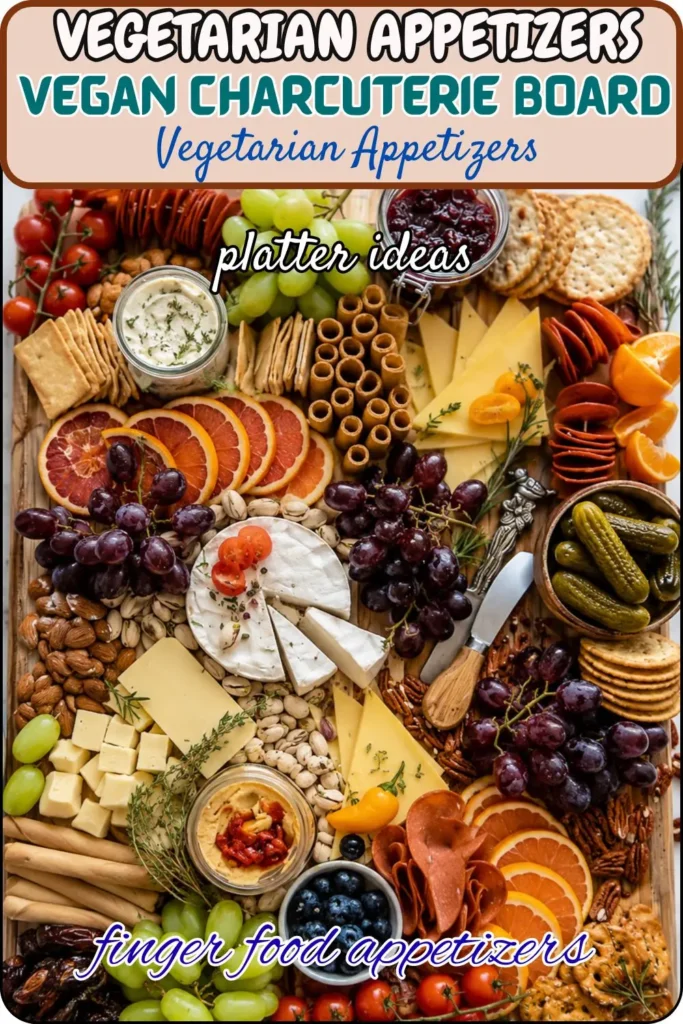
I started building vegan charcuterie boards when I needed a party contribution that would satisfy everyone at the table vegans, vegetarians, and curious omnivores without requiring anyone to identify their food as the “alternative option.” A well-built vegan board doesn’t announce itself as vegan. It announces itself as genuinely beautiful and clearly worth eating, and people figure out the rest themselves while reaching for a second piece of vegan cheese.
My Recipe Timing and Serving Details
| Detail | Info |
| Prep Time | 30 minutes |
| Cook Time | 0 minutes |
| Total Time | 30 minutes |
| Servings | 10 people |
| Approximate Calories | 75 kcal per serving (base) |
| Course | Appetizer / Entertaining |
| Diet | 100% Vegan |
This board serves 10 people as an appetizer or grazing spread. At approximately 75 kcal per serving as a starting baseline which increases significantly based on what you load onto it and how much each person consumes this is genuinely one of the most calorie-flexible party food formats possible. Light grazers stay light; enthusiastic eaters find substantial satisfaction. The 30-minute prep covers all the slicing, arranging, and bowl-filling.
The Seven Categories That Make a Complete Vegan Charcuterie Board
Every genuinely impressive vegan charcuterie board uses the same basic architecture seven category types that provide variety in flavor, texture, color, and function. Miss one and the board feels slightly incomplete; include all seven and the board looks like a professional styled it.
Category 1 – Vegan Cheeses (8 oz wheels/blocks + 8 oz slices)
Vegan cheese is the anchor ingredient – the category that defines the entire board’s character and establishes its centerpiece items. Choose one soft variety and one hard variety for maximum textural contrast:
Best soft vegan cheeses:
- Miyoko’s Creamery Cashew Brie – rounds perfectly, slices beautifully, and has a genuinely complex flavor that surprises guests
- Violife Greek White Block – firm enough to slice, mild enough to pair with anything
- Kite Hill Ricotta – spreadable directly from the container, beautiful with fruit
Best hard/firm vegan cheeses:
- Violife Just Like Cheddar – slices cleanly, stacks well, universally appealing flavor
- Follow Your Heart Gouda – excellent melting character even cold, good visual slices
- Miyoko’s Smoked Farmhouse – the most sophisticated flavor option for guests who know their cheese
The slice placement technique- Place cheese wheels or blocks whole on the board first they’re your largest items and define the board’s geography. Place cheese slices fanned or stacked near the wheels to create visual variety.
Category 2 -Vegan Deli Meats (16 oz, 2-3 varieties)
Vegan deli meats add color, protein, and visual drama through folding and arrangement techniques that create the most recognizable “charcuterie” visual elements:
- Tofurky Deli Slices – the most widely available, folds well
- Field Roast Smoked Tomato – exceptional flavor, beautiful color
- Upton’s Naturals Seita– more substantial texture for hearty eaters
The meat arrangement technique- Fold slices into quarters and stand them upright in overlapping rows this creates the rippled, full appearance of traditional charcuterie meat presentation. Use toothpicks to hold folded pieces in place if needed.
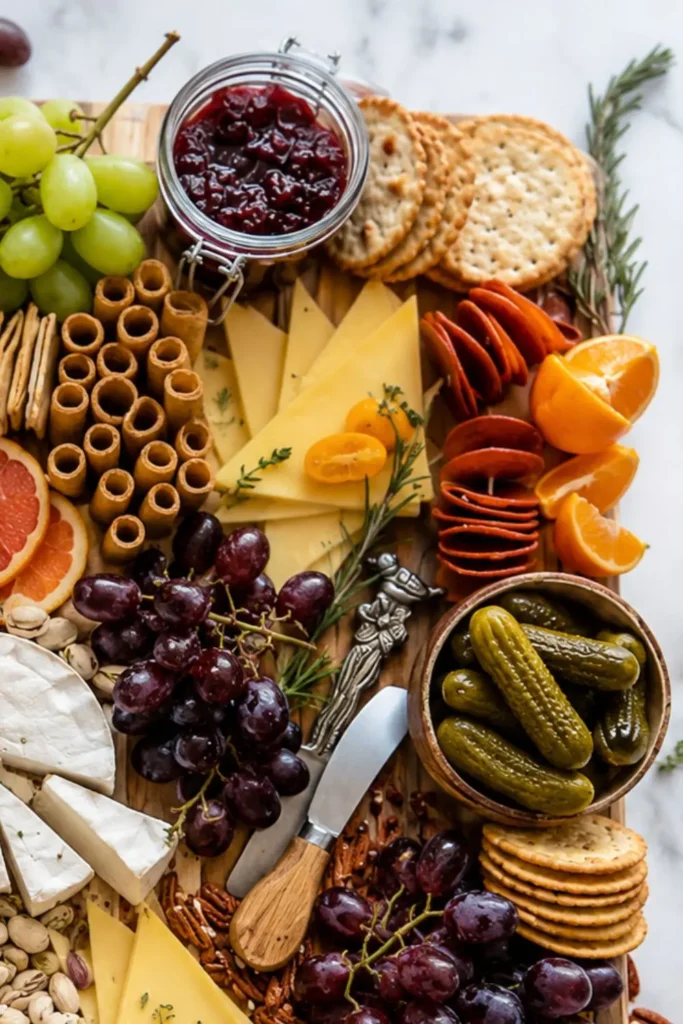
Category 3 – Spreads (6 oz cheese spread + 8 oz jam/jelly)
Spreads create the “bridges” on a charcuterie board – they connect the cheese to the crackers, the sweet to the savory, and give guests the interactive element that makes grazing genuinely fun.
Best vegan cheese spreads:
- Violife Cream Cheese – neutral, spreadable, works with sweet and savory
- Kite Hill Chive Cream Cheese – more interesting flavor, beautiful with crackers
- Store-bought or homemade hummus – a completely legitimate replacement that adds protein
Best jam/jelly combinations:
- Fig jam + pepper jelly – the most sophisticated sweet-and-heat pairing for a cheese board
- Strawberry jam + apricot preserves – crowd-pleasing, universally accessible
- Blackberry jam + hot pepper jelly – the combination that earns compliments consistently
Place spreads in small bowls or ramekins rather than directly on the board this creates contained, elegant presentation and allows guests to use the spreads without disrupting the board’s arrangement.
Category 4 – Dried Nuts and Fruits (16 oz nuts + 8 oz dried fruit)
Nuts and dried fruits fill the negative space on your board the gaps between anchor items while providing essential flavor contrast (sweet, salty, crunchy, chewy) that makes grazing continuously interesting.
Best nuts for a vegan charcuterie board:
- Candied walnuts – IMO the single best nut addition, sweet-savory and genuinely addictive
- Marcona almonds – Spanish-style almonds that feel more elegant than standard almonds
- Spiced pecans – warm spice notes that bridge cheese and sweet elements beautifully
- Pistachios in shell -visual interest and interactive quality that makes the board more dynamic
Best dried fruits:
- Dried cranberries – tart contrast that cuts through rich cheese
- Dried mango – tropical sweetness that pairs surprisingly well with smoky vegan cheese
- Medjool dates – rich, caramel-sweet, genuinely elevated as a board component
Category 5 – Pickled Goods (10 oz variety)
Pickled items provide the acidity that every charcuterie board needs – they cut through richness, reset the palate between bites, and create the savory-sour contrast that makes the sweet elements taste sweeter and the rich elements taste more interesting.
Essential pickled board components:
- Cornichons or gherkins – the classic, genuinely non-negotiable on any proper board
- Castelvetrano olives – buttery, mild, the olive that converts olive skeptics
- Capers – intense briny punch in small quantities
- Pepperoncini – gentle heat, beautiful color, widely loved
- Pickled jalapeños – for guests who want heat with their cheese
Place pickled items in small bowls or pile them in sections directly on the board – the brine should stay contained rather than running over surrounding components.
Category 6 -Crackers and Breads (24 oz variety)
Crackers and bread are the vehicle for everything else on the board choose at least 3 varieties to provide different textures, flavors, and serving options.
The best cracker variety strategy:
- One plain water cracker or oyster cracker -eutral, lets cheese flavors lead
- One seeded or multigrain cracker – more complex flavor and visual interest
- One artisan cracker or flatbread – the statement piece, often the one people photograph
Bread options:
- Sliced baguette (most universally loved)
- Crostini (toasted baguette slices)
- Breadsticks (visual interest, elegant format)
Arrange crackers in fanned stacks or overlapping rows rather than piling randomly — the arranged presentation looks intentional and makes it easier for guests to take individual crackers without the stack collapsing.
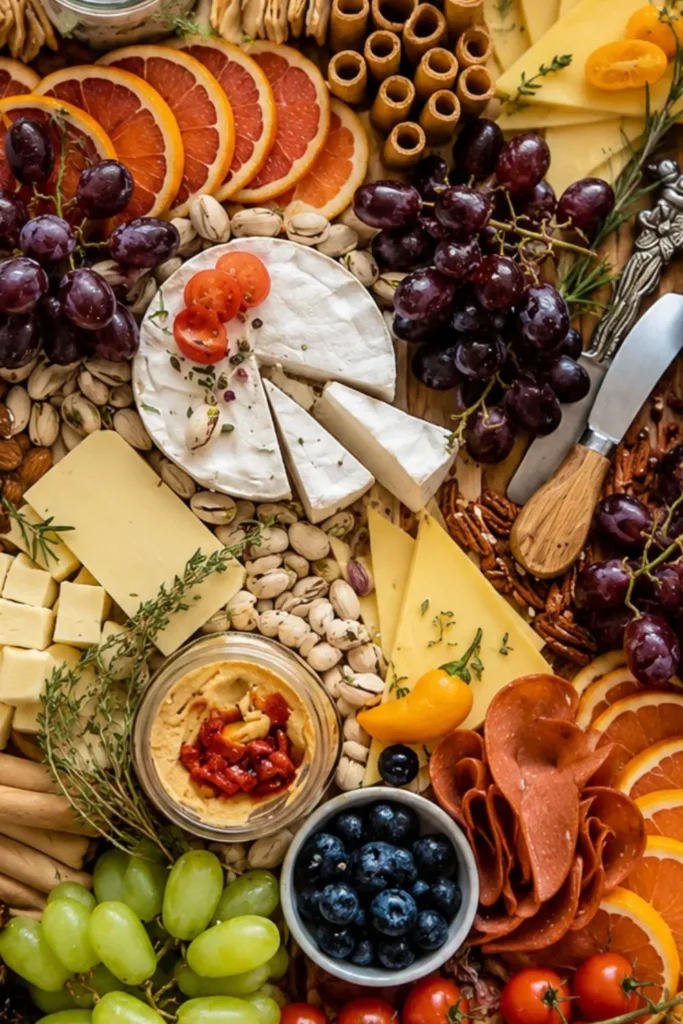
Category 7 – Fresh Fruit and Vegetables (8 oz berries + 8 oz tomatoes + 8 oz peppers)
Fresh produce is what makes a vegan charcuterie board specifically beautiful compared to traditional boards the vibrant colors, the freshness, and the variety create visual impact that makes the board genuinely stunning rather than merely impressive.
Best fresh fruit choices:
- Red and green grapes in clusters – drape naturally and look abundant
- Strawberries -hulled, halved for visual cross-sections, bright red impact
- Fresh figs when in season – the most elegant fruit board option, split in half
- Blueberries – scattered naturally in gaps, beautiful color
Best fresh vegetable choices:
- Cherry tomatoes – whole or halved, vibrant red or mixed colors
- Mini sweet peppers – sliced into rings, adds color and crunch
- Cucumber slices – green color, refreshing crunch
- Baby carrots – accessible, universally liked, pairs well with hummus
Try It Next recipe

Step by Step For Vegan Charcuterie Board
Step 1 – Choose and Prepare Your Board
A large wooden cutting board, a slate serving board, a marble slab, or even a large serving platter all work beautifully. Larger is always better a crowded board looks less generous than a board with visual breathing room.
Standard sizes and what they serve:
- 12×18 inch board- Serves 6-8 people as a light appetizer
- 18×24 inch board- Serves 10-12 people as a generous grazing board
- Larger slate or custom board- For 15+ people or an abundant visual statement
Step 2 – Place Anchor Items First
Add your vegan cheese wheels or blocks first these are your largest items and define the board’s layout. Place them at different positions across the board rather than grouped together. Place your spread bowls next, tucking them between the cheese items.
Step 3 – Build Outward from Anchors
Add your vegan deli meat arrangements near the cheese items folded and fanned in the traditional charcuterie style. Place cracker stacks and bread in logical serving positions near the spreads.
Step – Fill with Supporting Elements
Scatter nuts and dried fruits in the gaps between anchor items. Add pickled goods in small bowls or in direct piles. Distribute fresh fruit and vegetables to fill remaining space and add color throughout.
Step 5 – Garnish and Final Touches
Fresh herb sprigs rosemary, thyme, or sage tucked into gaps add color and fragrance that make the board smell as good as it looks. A few leaves of fresh basil scattered across the fruit sections completes the fresh herb element.
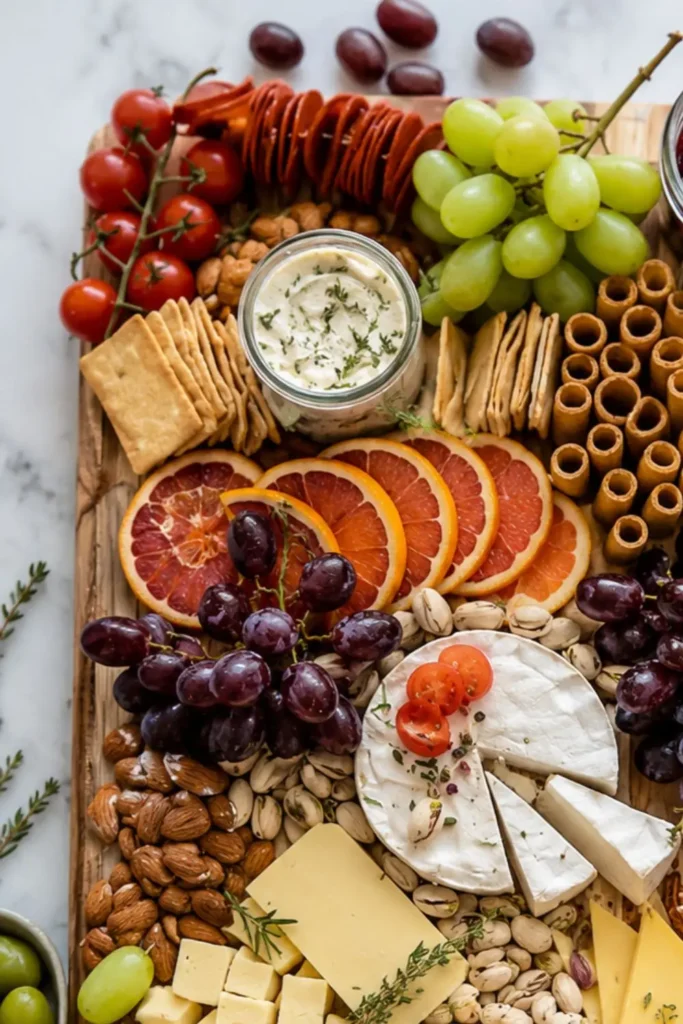
Vegan Charcuterie Board Ideas Themed Variations
Italian-Inspired Board
Violife Mozzarella + sun-dried tomatoes + Castelvetrano olives + crostini + basil pesto spread + prosciutto-style vegan slices + fresh figs + balsamic reduction
Mediterranean Board
Hummus + roasted red pepper dip + pita crisps + Kalamata olives + cucumber + pepperoncini + vegan feta crumbles + fresh herbs throughout
Autumn Harvest Board
Miyoko’s Cashew Brie + Violife Smoked Cheddar + candied pecans + dried cranberries + apple slices + fig jam + rosemary crackers + spiced walnuts
Game Day Board
Vegan nacho cheese dip + buffalo-style vegan deli slices + celery + carrot sticks + tortilla chips + jalapeños + vegan ranch dressing + buffalo sauce
Equipment You’ll Need For
- Large board or serving surface – at minimum 18 inches wide for 10 people
- 3-5 small ramekins or bowls – for spreads, jams, and pickled items
- Small tongs or appetizer picks – for pickled items and olives
- Cheese knives – at least 2, one per cheese type ideally
- Toothpicks -for folded deli meat arrangements
- Small spoons – for serving jam and spreads
Nutrition Overview
At approximately 75 kcal per serving as a baseline:
| Detail | Info |
| Carbohydrates | 9g |
| Protein | 1g |
| Fat | 4g |
| Fiber | 2g |
| Vitamin C | 22mg |
FYI the 75 calorie baseline reflects a very conservative single-serving estimate. Actual consumption varies enormously based on what’s on the board and how enthusiastically your guests graze. This is party food math, not nutrition science.
Make-Ahead Strategy
- 1 day ahead- Slice all cheeses, prepare all nuts and dried fruits, make or buy spreads
- 2-4 hours ahead- Arrange the board completely except for fresh fruit, bread, and crackers
- 30 minutes before serving- Add crackers and bread, add fresh fruit and garnishes
Cover the assembled board tightly with plastic wrap for refrigeration. Allow it to sit at room temperature for 15-20 minutes before serving cold cheese doesn’t express its full flavor.
My Final Thoughts
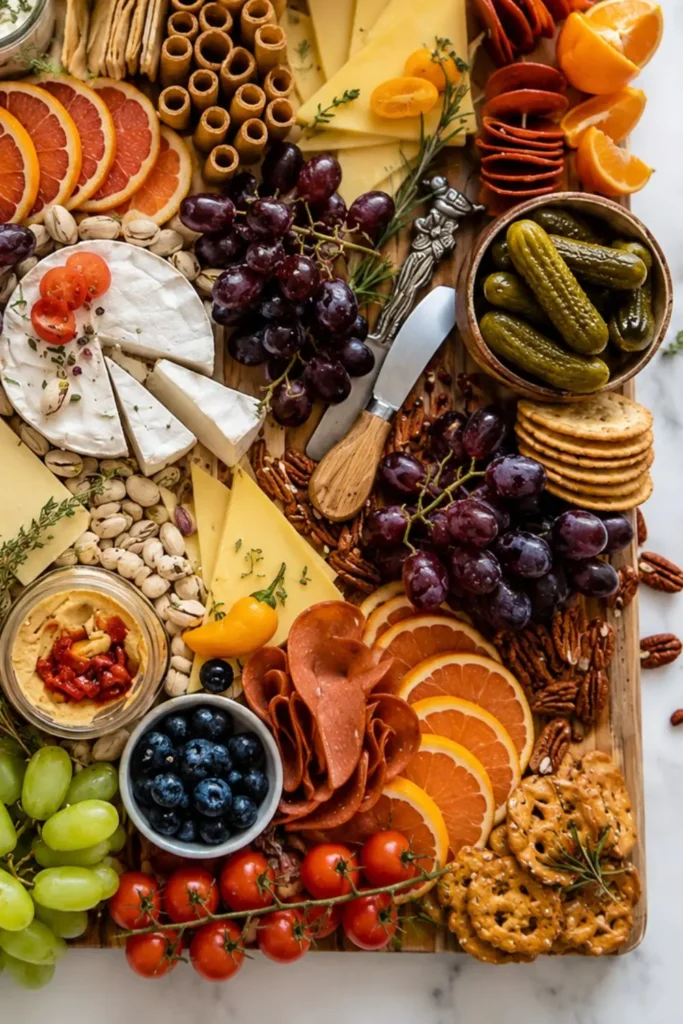
How to Build a Stunning Vegan Charcuterie Board comes down to seven categories, one good board, and 30 minutes of thoughtful arrangement. The result serves 10 people, starts at 75 calories per serving, requires zero cooking, and produces the most photographed item at any party you bring it to.
Quality vegan cheese is worth the investment. Good crackers matter. Fresh herbs as garnish take 30 seconds and make everything look significantly more intentional.
Build it once, photograph it, and watch your guests graze from it for the entire evening. That’s genuinely what a great board does.
Vegan Charcuterie Board
Ingredients
Equipment
Method
- Step 1 – Choose and Prepare Your Board
- A large wooden cutting board, a slate serving board, a marble slab, or even a large serving platter all work beautifully. Larger is always better a crowded board looks less generous than a board with visual breathing room.
- Standard sizes and what they serve:
- 12×18 inch board- Serves 6-8 people as a light appetizer
- 18×24 inch board- Serves 10-12 people as a generous grazing board
- Larger slate or custom board- For 15+ people or an abundant visual statement
- Step 2 – Place Anchor Items First
- Add your vegan cheese wheels or blocks first these are your largest items and define the board’s layout. Place them at different positions across the board rather than grouped together. Place your spread bowls next, tucking them between the cheese items.
- Step 3 – Build Outward from Anchors
- Add your vegan deli meat arrangements near the cheese items folded and fanned in the traditional charcuterie style. Place cracker stacks and bread in logical serving positions near the spreads.
- Step – Fill with Supporting Elements
- Scatter nuts and dried fruits in the gaps between anchor items. Add pickled goods in small bowls or in direct piles. Distribute fresh fruit and vegetables to fill remaining space and add color throughout.
- Step 5 – Garnish and Final Touches
- Fresh herb sprigs rosemary, thyme, or sage tucked into gaps add color and fragrance that make the board smell as good as it looks. A few leaves of fresh basil scattered across the fruit sections completes the fresh herb element.
Notes
Nutrition Overview
At approximately 75 kcal per serving as a baseline:| Detail | Info |
| Carbohydrates | 9g |
| Protein | 1g |
| Fat | 4g |
| Fiber | 2g |
| Vitamin C | 22mg |

Hi — I’m Rachel. I’m a wife, a mom, and a home cook who believes that food should bring comfort, joy, and compassion to the table. I live with my family — two hungry little foodies who are my most honest recipe testers — and together we’ve built a kitchen culture that’s all about good food that happens to be 100% vegan. I started this blog because I wanted a place to share the recipes that keep our days moving, the dishes that make weeknights feel a little easier, and the meals that become our little family traditions.