Go Back
Easy Vegan Gazpacho Breakfast Cups 

Easy Vegan Gazpacho Breakfast Cups

Breakfast doesn't have to be sweet. It doesn't even have to be warm. Easy Vegan Gazpacho Breakfast Cups are the summer morning revelation that cold tomato soup bright, slightly smoky, garden-fresh, and packed with peak-season vegetables makes one of the most energizing and genuinely satisfying starts to a summer day. This isn't just gazpacho repurposed for breakfast for novelty's sake. The combination of fresh tomatoes, cucumber, red pepper, basil, smoked paprika, and a touch of soy sauce creates something that's deeply hydrating, vitamin-rich, and absolutely delicious served ice-cold in a cup or small bowl before the day's heat arrives.
Prep Time 10 minutes
Cook Time 30 minutes
Total Time 40 minutes
Servings: 6
Course: Breakfast, healthy breakfast, summar breakfast, vegan breakfast
Cuisine: American
Calories: 63

Ingredients
  

  • Peak-season produce plus a few pantry items:
  • The Fresh Vegetables:
  • 2 pounds fresh tomatoes the most important ingredient; peak-season is essential
  • 1 cucumber peeled and seeded
  • 1 red pepper deseeded
  • 1 medium shallot
  • 1 clove garlic minced
  • ¼ cup fresh basil thinly sliced (added at serving)
  • The Liquid and Seasonings:
  • 2 cups tomato juice
  • 2 tablespoons red wine vinegar
  • 1 tablespoon low-sodium soy sauce or coconut aminos
  • 1 teaspoon maple syrup
  • ½ teaspoon smoked paprika
  • ½ teaspoon ground black pepper
  • The 2 pounds of fresh tomatoes is genuinely the recipe's defining ingredient and peak summer tomatoes at their sweetest most complex, and most flavorful produce a gazpacho that tastes dramatically better than one made with off-season tomatoes. Roma tomatoes provide good balance of sweetness and acidity. Heirloom varieties add color variety and complex flavor. A combination of both is IMO the best approach the flavor range from different tomato varieties creates more interesting gazpacho than any single variety alone.

Equipment

  • This recipe uses a blender or food processor as its primary tool:
  • The Blender or Food Processor
  • The recipe recommends either a food processor or blender and each produces slightly different results:
  • Food processor - better for the initial chunky processing stage. The wide bowl and chopping blade creates a controlled, even texture when you pulse the vegetables. You control the texture precisely by counting pulses rather than blending continuously.
  • High-powered blender - better for the smooth purée stage. A Vitamix or Blendtec creates a completely smooth, velvety purée that a food processor can't quite match. If you have both, use the food processor for the chunky portion and the blender for the smooth purée.
  • Standard blender - works adequately for both stages if it's what you have. Blend in short pulses for the chunky portion and on high for the smooth purée.

Method
 

  1. Step 1 - Roughly Chop and First Blend
  2. Roughly chop the tomatoes, peeled and seeded cucumber, red pepper, shallot, and garlic into large chunks no precise size needed, just large enough to fit in the food processor.
  3. Add everything to your food processor bowl. Pulse approximately 8–10 times until the mixture breaks down to a chunky, pico de gallo-like consistency you want visible vegetable pieces, not a smooth purée. Every vegetable should be broken down but still distinctly recognizable.
  4. Remove approximately 1 cup of this chunky mixture and set it aside in a separate bowl. This becomes the textural element that gets added back at the end.
  5. Step 2 - Create the Smooth Purée
  6. Add the tomato juice, red wine vinegar, soy sauce or coconut aminos, maple syrup, smoked paprika, and black pepper to the remaining vegetable mixture in the blender.
  7. Blend on high speed until completely smooth approximately 60–90 seconds in a high-powered blender, 2–3 minutes in a standard blender. Stop and scrape down the sides once or twice if needed. The finished purée should be silky and uniform with no visible vegetable pieces.
  8. Step 3 - Combine and Chill
  9. Pour the smooth purée into a large pitcher or bowl. Add the reserved chunky vegetable mixture and stir well to combine evenly throughout. Cover and refrigerate.
  10. Minimum chill time: 30 minutes adequate for a quick serving. Optimal chill time: 2 hours this allows the flavors to meld and deepen significantly, the smoked paprika to fully infuse throughout, and the gazpacho to reach the genuinely cold temperature that makes it so refreshing as a breakfast cup.
  11. The flavor improvement between 30-minute and 2-hour gazpacho is significant. If you're serving this for a weekend brunch, make it the night before. The overnight version is the best version.
  12. Step 4 - Taste and Adjust
  13. Before serving, taste the gazpacho and adjust seasoning. More vinegar if it needs more acidity. More maple syrup if the tomatoes are very acidic and need balancing. More smoked paprika for additional smokiness. More black pepper for heat.
  14. This seasoning adjustment is important because tomatoes vary significantly in sweetness and acidity depending on variety, ripeness, and growing conditions. The recipe's measurements are a starting point your specific tomatoes may need adjustment.
  15. Step 5 - Serve in Cups
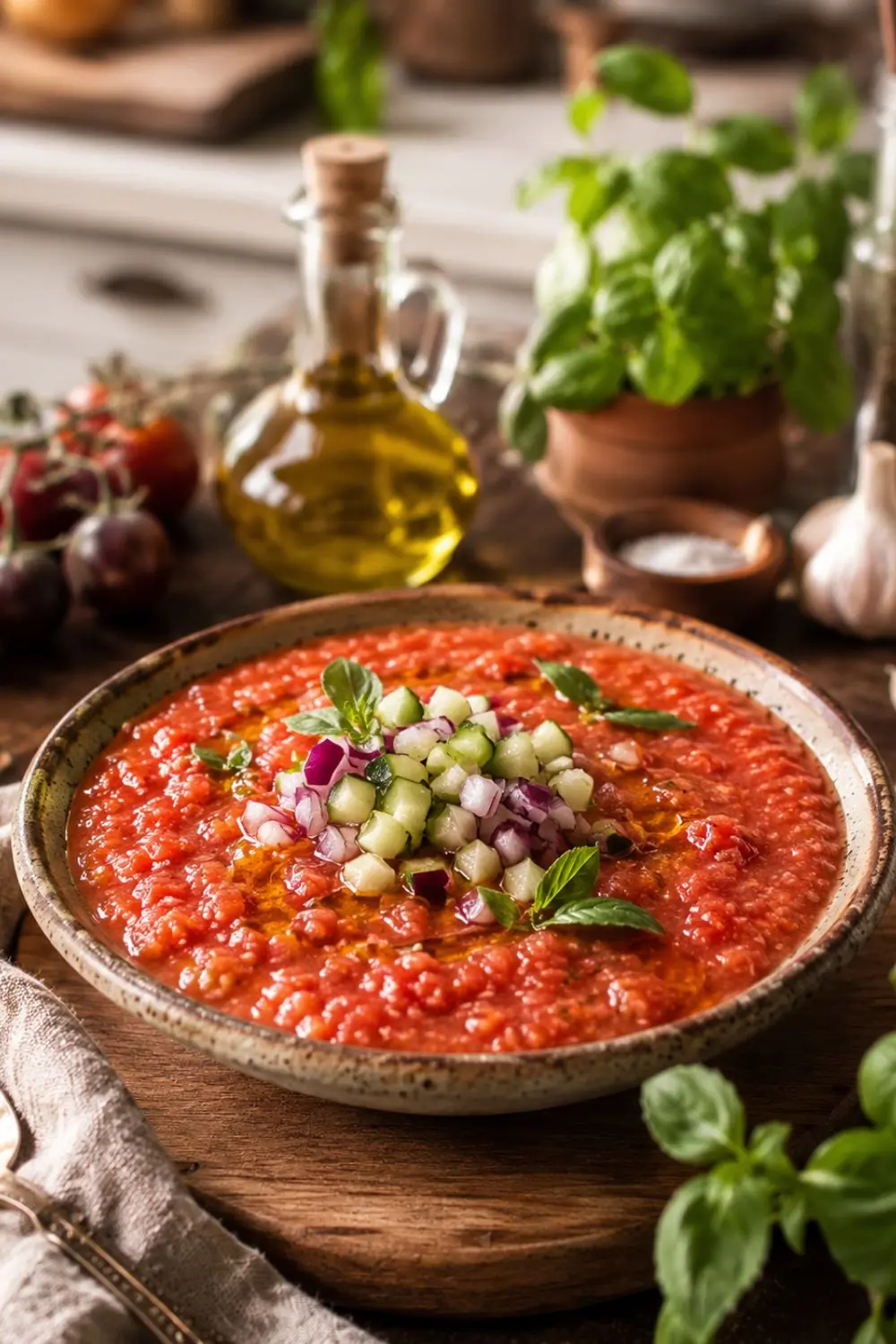
  16. Pour the chilled gazpacho into small cups or bowls. Top with fresh basil thinly sliced add this immediately before serving rather than in advance. Basil oxidizes quickly and loses its vibrant green color and fresh flavor within minutes of slicing. Keep it as a just-before-serving addition.
Notes

Nutrition Information Per Serving

At just 63 calories per serving, this gazpacho is nutritionally extraordinary:
Nutrient
Per Serving
Calories
63 kcal
Carbohydrates
14g
Protein
3g
Fat
1g
Fiber
3g
Sugar
9g
Sodium
115mg
Potassium
693mg
Vitamin A
2,417 IU
Vitamin C
63mg