Go Back
Easy Vegan Potato Salad (No Egg, No Dairy)

Easy Vegan Potato Salad (No Egg, No Dairy)

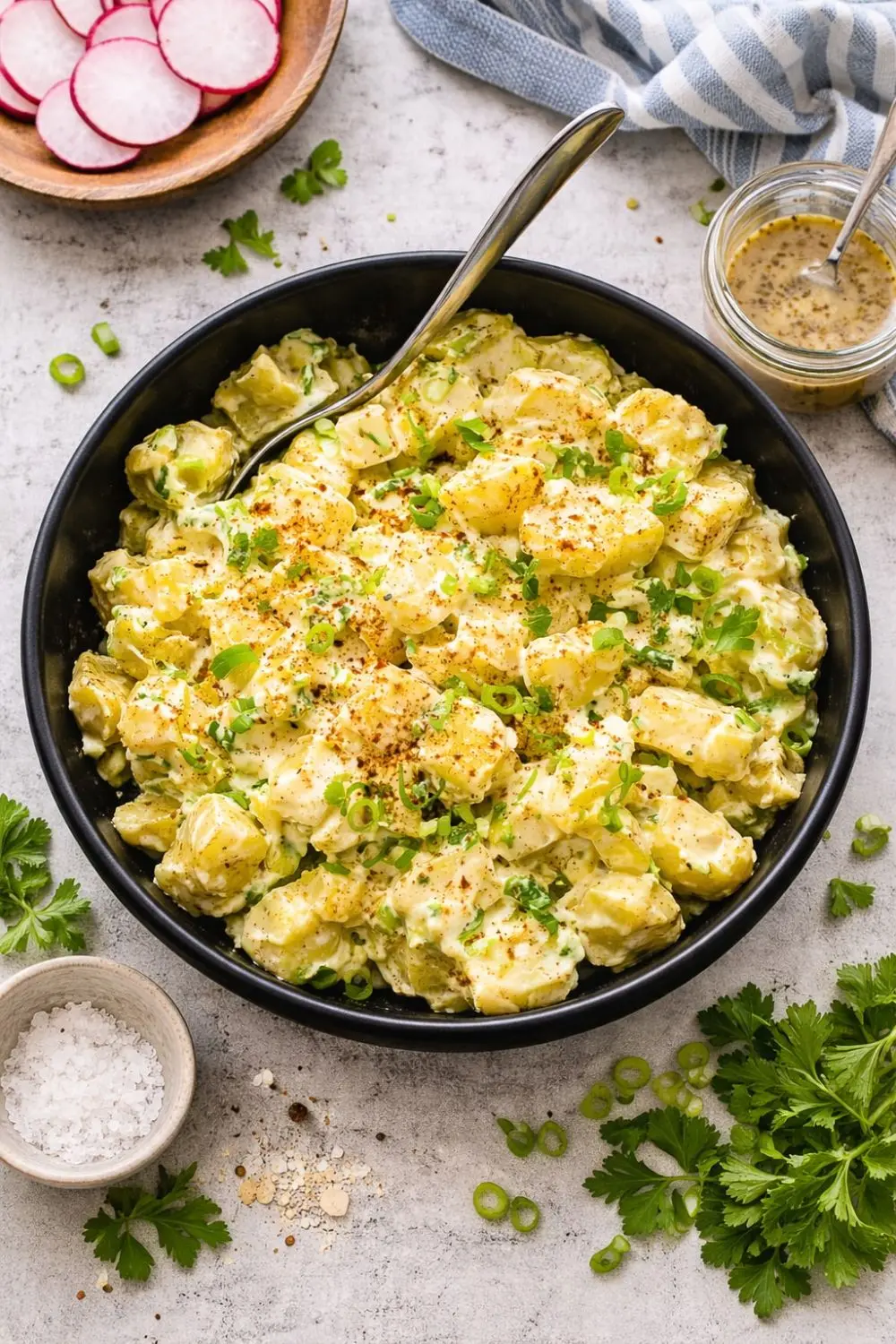
Not every potato salad needs to reinvent the format. Sometimes you just want the classic the one your grandmother made, the one that shows up at every family picnic, the one with celery crunch, sweet pickle relish, and that familiar tang of mustard and mayo. This Easy Vegan Potato Salad (No Egg, No Dairy) is exactly that classic, rebuilt with entirely plant-based ingredients so it tastes like the version you grew up with, minus the eggs and dairy.
Prep Time 15 minutes
Cook Time 15 minutes
Total Time 30 minutes
Servings: 13
Course: Dairy free, Gluten-free, Salad, Side Dish
Cuisine: American
Calories: 137

Ingredients
  

  • The Potatoes
  • 4 pounds russet potatoes about 8 medium, peeled and cut into 1-inch cubes — Russet potatoes are the deliberate, correct choice for this classic-style potato salad. Unlike the waxier potato varieties that work better for chunkier, more textured potato salad styles, russets have a higher starch content that creates the soft, slightly fluffy texture that defines traditional potato salad. They absorb the mayo-mustard dressing beautifully and create that familiar, comforting mouthfeel that people associate with classic potato salad.
  • Peel them before cubing the skin doesn't integrate well into this style of potato salad and can create a slightly tough texture against the soft potato interior. Cut into even 1-inch cubes so everything cooks at the same rate.
  • The Crunch and Tang
  • 2 cups celery sliced very thin -Celery is the textural backbone of classic potato salad. Slice it thin thick chunks of celery are tough to bite through and create an uneven texture against the soft potatoes. Thin slices integrate seamlessly and provide that essential crunch in every forkful without overwhelming the dish.
  • ½ cup white onion minced - White onion has a sharper, more pungent bite than red or yellow onion, which is exactly right for this style of potato salad. Mince it finely rather than dicing large onion pieces can be overpowering, while finely minced onion distributes its flavor evenly through the entire bowl without any single bite tasting overly onion-forward.
  • ½ cup sweet pickle relish - This is the ingredient that defines classic American potato salad flavor. The sweet-tangy quality of pickle relish balances the savory mayo and sharp mustard and it's genuinely the ingredient most people miss if it's left out. Use a quality sweet relish the flavor difference between brands is noticeable in a recipe this simple.
  • The Dressing
  • ½ cup vegan mayo - The base of the dressing. Use a quality vegan mayo this single ingredient carries an enormous amount of the final flavor and texture so it's not the place to compromise. Just Mayo, Vegan Hellmann's, and Sir Kensington's Vegan Mayo are all excellent, widely available choices that taste remarkably close to conventional mayo. If you prefer making your own, a simple homemade vegan mayo (soy milk, neutral oil, vinegar, mustard, blended until emulsified) works beautifully and lets you control the exact flavor.
  • 1½ tablespoons yellow mustard - Classic yellow mustard not Dijon. The mild, tangy, slightly vinegary quality of yellow mustard is what gives traditional potato salad its recognizable flavor profile. Dijon is too sharp and sophisticated for this specific application save it for other recipes.
  • ¾ teaspoon sea salt - Season generously. Potatoes need real salt to taste like something rather than bland starch with mayo on top.
  • ¼ teaspoon black pepper - A subtle background note that rounds out the flavor without adding noticeable heat.

Equipment

  • Three simple pieces of equipment:
  • A stock pot - Use a medium-large pot, big enough to hold 4 pounds of cubed potatoes comfortably covered in water with room to boil without overflowing. The size of your pot directly affects how evenly the potatoes cook overcrowded potatoes in a small pot heat unevenly.
  • A colander - For draining the boiled potatoes. Make sure it's large enough to handle the full batch in one go rather than draining in multiple smaller batches, which slows down the process and lets the potatoes continue cooking in residual steam longer than you want.
  • A large mixing bowl - Big enough to combine 4 pounds of potatoes with all the remaining ingredients while leaving room to fold gently without potatoes flying out. Bigger is always better here than you think you need.
  • That's genuinely the complete equipment list. No blender, no food processor, no specialty tools. This is straightforward, classic cooking.

Method
 

  1. Step 1 - Boil the Potatoes Correctly
  2. Add the peeled, cubed potatoes to your stock pot. Cover completely with water and add a generous pinch of salt to the water this seasons the potatoes from the inside as they cook, which matters significantly more than seasoning after the fact. Bring to a boil over high heat.
  3. Once boiling, reduce the heat to medium and cook for about 5 minutes, or until the potatoes are just barely fork-tender. This timing is the single most important detail in this entire recipe. Do not overcook them. Overcooked potatoes break down into the beginning stages of mashed potatoes, and once that happens, there's no rescuing the texture. Test frequently after the 4-minute mark a fork should slide in with slight resistance, not glide through effortlessly.
  4. Step 2 - Drain and Cool
  5. Drain the potatoes thoroughly in your colander and transfer them to the large mixing bowl. Let them cool for about 5–10 minutes before adding any other ingredients. This cooling step matters adding mayo-based dressing to hot potatoes causes the dressing to break down and separate slightly, and it also continues softening the potatoes past the point you want. A brief cool-down preserves the texture and keeps the dressing properly emulsified.
  6. Step 3 - Combine Everything
  7. Add the celery, minced white onion, sweet pickle relish, vegan mayo, yellow mustard, salt, and pepper directly to the bowl with the cooled potatoes. Using a large spoon, mix everything together until well combined. Be careful not to mash or crush the potatoes during this step you're folding and combining, not stirring aggressively. A gentle hand here preserves the distinct potato cube texture that makes a good potato salad satisfying to eat.
  8. Step 4 - Chill and Serve
  9. Cover the bowl and refrigerate until completely cold at least 1–2 hours, though overnight is genuinely better. The chilling time is when the flavors actually develop and meld together. A potato salad eaten immediately after mixing tastes fine; the same potato salad eaten the next day after a full chill tastes significantly more cohesive and developed. Serve cold.
Notes

Full Nutritional Breakdown (Per Serving — 5 oz, 1 of 13)

Nutrient
Amount
Calories
137 kcal
Carbohydrates
30g
Protein
4g
Fat
1g
Saturated Fat
0.1g
Fiber
2g
Sugar
4g
Sodium
286mg
Potassium
653mg
Vitamin C
9mg
Calcium
31mg
Iron
1mg