Step 1 - Preheat and Prepare
Preheat the oven to 160°C/320°F fan or 180°C/356°F conventional. Line the base of both cake tins with parchment circles and liberally grease the sides with oil or vegan butter.
If you haven't already made and cooled your espresso/coffee, do that now it must be at room temperature before use.
Step 2 - Make the Vegan Buttermilk
Combine the plant milk and apple cider vinegar, stir, and set aside for 10 minutes while you prepare everything else.
Step 3 - Mix Dry Ingredients
In your large mixing bowl, whisk together the finely chopped walnuts, sifted flour, brown sugar, baking powder, baking soda, and sea salt until evenly combined. The walnuts distribute through the flour at this stage they'll stay suspended throughout the batter and bake evenly distributed through the cake.
Finely chopping the walnuts is specifically required roughly chopped walnuts create large gaps in the cake's crumb structure and uneven texture. Aim for pieces no larger than ¼ inch. A food processor produces the most consistent fine chop in seconds.
Step 4 - Mix Wet Ingredients
In a separate medium bowl, whisk together the cooled espresso, vegan buttermilk, olive oil, and vanilla extract until uniformly combined.
Step 5 - Combine and Bake
Pour the wet ingredients into the dry ingredients. Whisk until no visible pockets of flour remain be careful not to over-mix beyond this point. Over-mixing develops gluten and produces a tough, dense cake. The moment the dry flour disappears, stop.
Divide the batter evenly between the two prepared tins. Bake for 35–45 minutes until a toothpick inserted into the center comes out clean.
Allow to cool in the pans for 10–15 minutes, then transfer to wire racks to cool completely. Refrigerate the cooled layers in an airtight container until ready to assemble.
Step 6 - Make the Candied Walnuts
While the cake bakes and cools, add the 200g walnut halves, 2 tablespoons of sugar, and 1 tablespoon of vegan butter or olive oil to a skillet over medium-low heat. Cook for 5–7 minutes, tossing constantly this constant movement prevents the sugar from burning on the walnut surfaces.
The candying is complete when the sugar has fully melted and caramelized around the walnuts, they're evenly golden and fragrant, and the mixture is dry rather than wet.
Transfer immediately to a parchment-lined surface and spread out to cool they stick together if left in a pile. Once cool, separate: reserve 16 walnut halves for the individual top decorations and chop the remaining walnuts for filling and crumble garnish.
Step 7 - Assemble the Cake
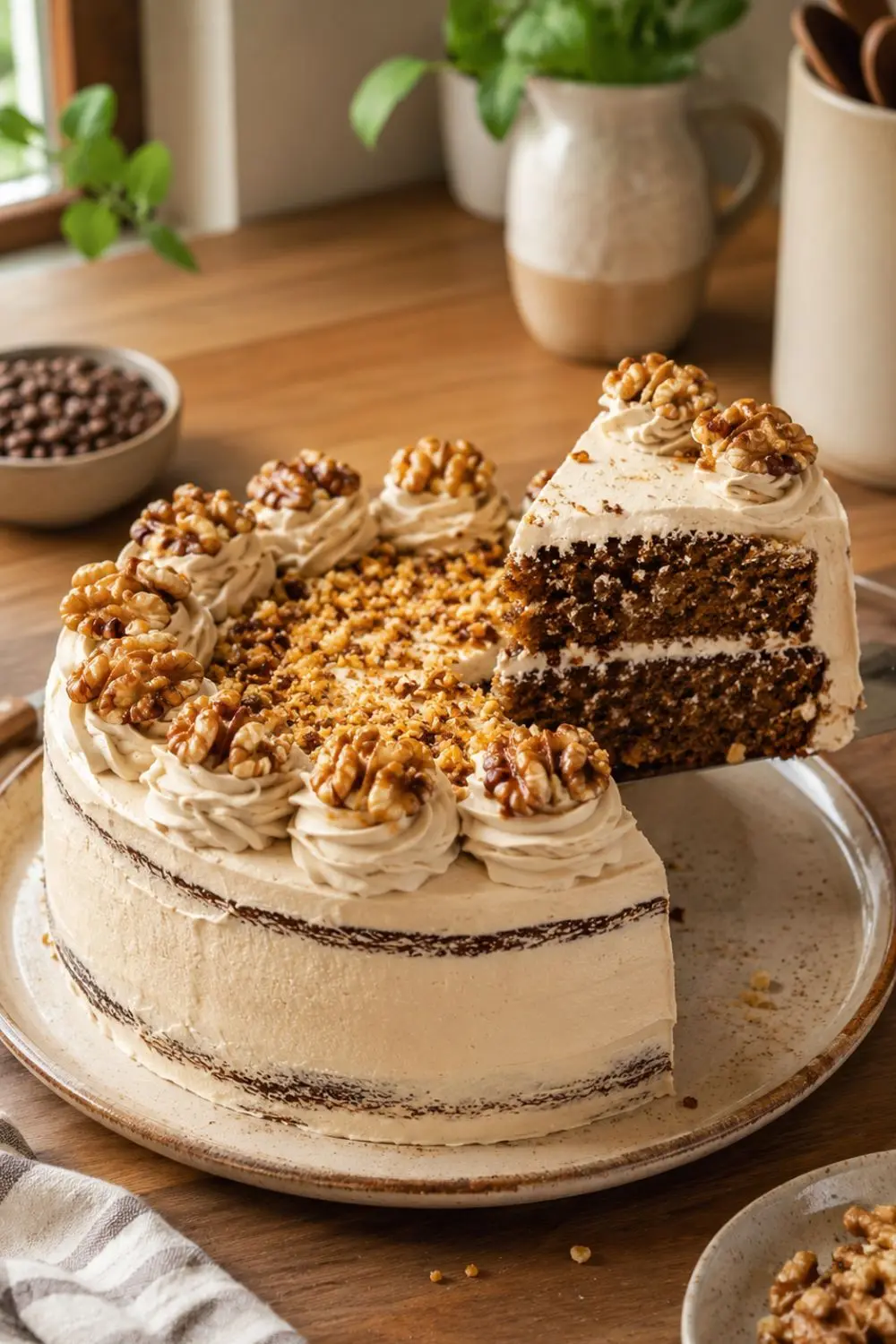
First layer- Place the first cake layer on your serving plate or cake stand. Spread approximately ⅓ of the coffee buttercream evenly across the top surface. Scatter half of the chopped candied walnuts over the frosting press them gently into the frosting surface so they stay in place when the second layer is added.
Second layer- Place the second cake layer on top. Use your offset spatula to coat the sides and top of the entire cake with approximately another ⅓ of the frosting. This is the exterior coat it doesn't need to be perfectly smooth for the final result to look impressive, but a consistent, even coverage creates the right backdrop for the decorative top.
Top decoration- Transfer the remaining ⅓ of frosting to a piping bag and pipe across the top of the cake in your preferred pattern. Place the 16 reserved candied walnut halves evenly around the top one per intended serving slice, which guides portioning. Sprinkle the remaining chopped candied walnuts across the piped frosting.