Go Back
Vegan Gluten Free Carrot Cake 

Vegan Gluten Free Carrot Cake

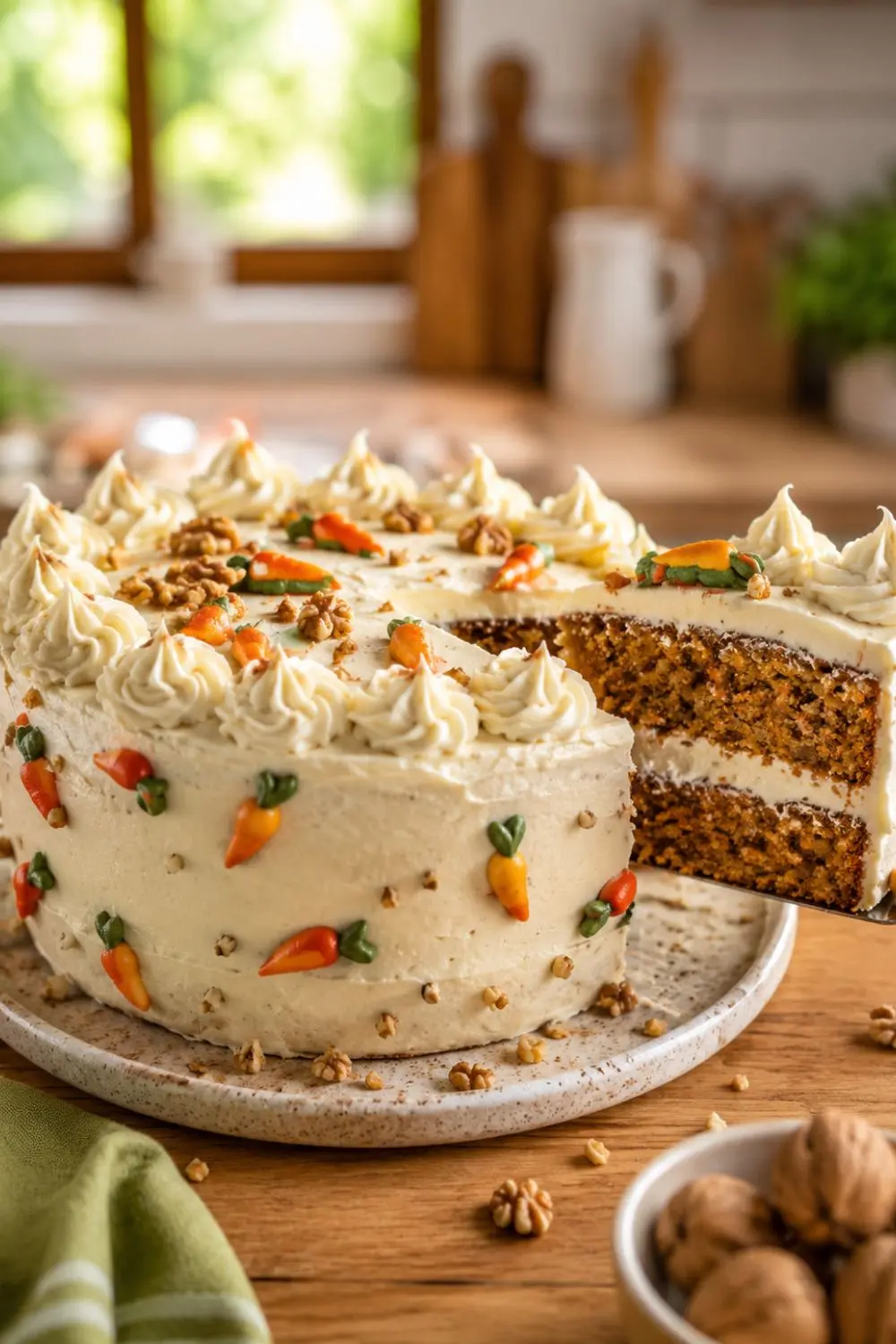
Carrot cake has absolutely no business being as good as it is. Grated carrots, warm spices, walnuts, and one of the best frostings in the dessert world and every single version I grew up eating had eggs, butter, and cream cheese made from dairy. This vegan gluten free carrot cake has none of that and loses absolutely nothing in the process. It's tender, warmly spiced, properly moist, and finished with a vegan cream cheese frosting that's thick, tangy, and genuinely impossible to stop eating.
Prep Time 30 minutes
Cook Time 40 minutes
Total Time 1 hour 10 minutes
Servings: 16
Course: Blueberry Cake, Dessert, Gluten-free, Vegan Lemon Blueberry
Cuisine: American
Calories: 229

Ingredients
  

  • Dry Ingredients
  • 3 cups 375g all-purpose plain flour or GF flour blend, spooned and leveled - The spoon-and-level method is essential. Fluff the flour in its bag, use a spoon to add it to your measuring cup, then level with a straight edge. Never scoop directly from the bag scooping compacts the flour and adds up to 30% more than needed, producing a dry, dense cake. For the gluten-free version, King Arthur Measure for Measure flour works beautifully as a 1:1 replacement. Your batter may look slightly thicker than with regular flour that's normal. Bake for 40–45 minutes instead of 35–40.
  • 1 cup 190g packed brown sugar - Brown sugar adds a molasses depth that pairs perfectly with the warm spices in carrot cake. It's what gives the cake its characteristic richness and slightly caramel undertone.
  • ½ cup 100g granulated sugar - The combination of brown and granulated sugar creates the right balance of sweetness and moisture.
  • 3 teaspoons baking powder -The primary lift. Without eggs for structure this amount of baking powder is what gives you a properly risen, airy cake.
  • ½ teaspoon baking soda - Works alongside baking powder and the apple cider vinegar in the wet ingredients to create additional lift and a more tender crumb.
  • 3 teaspoons ground cinnamon - The dominant spice and the one most associated with carrot cake flavor. Three teaspoons is correct don't reduce it.
  • 1 teaspoon ground nutmeg - Adds warmth and a slightly floral quality that lifts the whole spice profile.
  • ½ teaspoon ground ginger - Sharp slightly citrusy warmth that rounds out the spice blend.
  • ½ teaspoon salt - Balances all the sweetness and makes every other flavor taste more pronounced.
  • Wet Ingredients
  • 3 cups 300g coarsely grated carrots (about 3–4 medium carrots) - The carrots are doing more than adding flavor they're providing moisture, natural sweetness, and the texture that makes carrot cake identifiable. Coarse grating gives you visible shreds throughout the cake. Fine grating produces a more uniform crumb with less character. Peel the carrots before grating and grate them fresh pre-shredded bagged carrots are too dry and don't release enough moisture during baking.
  • 1¼ cups 315g dairy-free milk, room temperature - Room temperature milk is important. Cold milk slows the reaction between the baking powder and the batter, producing uneven rise. Take your milk out of the fridge 20–30 minutes before you start. Oat milk is my preference for carrot cake neutral flavor, good body, consistent results.
  • ½ cup 125g neutral oil - Sunflower, avocado, or refined coconut oil all work. Oil produces a moister, more shelf-stable cake than vegan butter, which is particularly important for a two-layer celebration cake that might sit in the fridge for a day before serving.
  • 1 cup 120g chopped walnuts or pecans (optional) - IMO, the nuts are not optional. They add textural contrast, healthy fats, and a depth of flavor that makes each vegan carrot cake slice taste more interesting. Walnuts are classic and slightly bitter; pecans are sweeter and buttery. Both are excellent choose based on your preference.
  • 1 tablespoon apple cider vinegar - Reacts with the baking soda to create additional lift and makes the crumb more tender. It also activates the dairy-free milk into a plant-based "buttermilk" effect.
  • 1 teaspoon vanilla extract - Adds aromatic warmth that rounds out the spices.
  • The Vegan Cream Cheese Frosting
  • This frosting is the reason this cake gets eaten first at every gathering. It's thick slightly tangy, sweet, and genuinely extraordinary on a vegan carrot cake slice.
  • ½ cup 115g vegan block butter, room temperature - Block butter (not spreadable tub butter) is essential for a frosting that holds its shape. Spreadable vegan butter has a higher water content that makes the frosting too soft and runny to pipe or spread cleanly.
  • 8 oz 240g vegan cream cheese, room temperature - Brands that work consistently well: Violife Creamy, Kite Hill, and Miyoko's. All three produce a frosting that's smooth, tangy, and stable. Both the butter and cream cheese must be room temperature -cold ingredients don't beat together smoothly and leave lumps in the finished frosting.
  • 4 cups 400g powdered sugar / icing sugar - Sifted first if it's been sitting in the pantry. Unsifted powdered sugar has tiny lumps that beat into the frosting unevenly.
  • 1 teaspoon vanilla extract - For the frosting's flavor base.
  • 3 tablespoons cornstarch optional - For a firmer frosting that holds piped shapes better. Add it if you want to pipe decorations; skip it if you're just spreading.

Equipment

  • More than a simple single-bowl recipe, but nothing specialist:
  • Two 8-inch (20cm) round cake pans - Both the same size so the layers bake evenly and stack cleanly. Grease them well and line the bottoms with parchment paper. Vegan cake batters without eggs can stick more than conventional batters the parchment is non-optional.
  • A large mixing bowl - For combining the dry and wet cake ingredients.
  • A whisk - For mixing dry ingredients and breaking up any lumps in the flour or spices.
  • A box grater or food processor with a grating attachment - For grating the carrots. A food processor is dramatically faster for 3 cups of grated carrot. A box grater works fine you'll just have more of a forearm workout. Coarsely grate the carrots, not fine coarse grating creates texture in the cake and more moisture pockets.
  • A stand mixer or hand mixer - For the cream cheese frosting. The frosting needs proper beating to become light and smooth mixing it by hand gives you an inconsistent result and takes considerably longer.
  • Two wire cooling racks - One per cake layer. The layers need to cool completely before frosting warm cake melts the frosting and creates a sliding, unstable mess.
  • An offset spatula - For spreading the frosting between layers and across the top and sides. An offset spatula gives you far more control than a straight knife.

Method
 

  1. Step 1 - Preheat and Prepare
  2. Preheat your oven to 180°C (355°F). Grease both 8-inch cake pans and line the bottoms with parchment. Set them aside.
  3. Step 2 - Mix the Dry Ingredients
  4. Add all dry ingredients to your large bowl and whisk thoroughly flour, both sugars, baking powder, baking soda, cinnamon, nutmeg, ginger, and salt. Whisk until there are no lumps and the spices distribute evenly through the flour. Properly mixed dry ingredients mean even spice distribution in every slice.
  5. Step 3 - Add the Wet Ingredients
  6. Add the grated carrots, dairy-free milk, oil, walnuts (if using), apple cider vinegar, and vanilla extract to the dry ingredients. Mix until just combined stop when no dry flour streaks remain. The batter will be quite thick, which is correct. Overmixing develops structure that makes gluten-free cakes tough.
  7. Step 4 - Divide and Bake
  8. Divide the batter evenly between your two prepared cake pans. Use a spatula to smooth the tops to an even level both layers should be the same thickness for a stable, flat stack. Bake for 35–40 minutes (40–45 minutes for the gluten-free version) until a toothpick inserted into the center comes out clean.
  9. Step 5 - Cool Completely
  10. This is non-negotiable. Let both layers cool in their pans on wire racks until they reach room temperature at least 45 minutes to an hour. Do not rush this. A warm cake layer will melt the frosting on contact and slide off the stack. Both layers must be fully cool.
  11. Step 6 -Make the Frosting
  12. Beat the room-temperature vegan butter in your stand mixer (or with a hand mixer) until light and fluffy about 2 minutes. Add the powdered sugar and beat until just combined. Add the vegan cream cheese and vanilla and beat until completely smooth with no lumps. Don't overbeat at this stage overbeating causes the cream cheese proteins to break down and makes the frosting soft and slightly grainy.
  13. If the frosting feels too runny, add extra powdered sugar a quarter cup at a time, or add the cornstarch and beat briefly. Refrigerate the frosting until you're ready to use it.
  14. Step 7 - Frost and Assemble
  15. Place the first cake layer on your serving plate. Spread about ¾ cup of frosting evenly across the top, right to the edges. Place the second layer on top, pressing down very gently to level. Spread the remaining frosting across the top and sides of the cake. Use your piping bag to add any decorative touches.
Notes

Full Nutritional Breakdown

Per slice without nuts or frosting (1 of 16):
Nutrient
Amount
Calories
229 kcal
Carbohydrates
36g
Protein
3g
Fat
8g
Fiber
1g
Sugar
18g
Sodium
216mg
Calcium
85mg
Iron
1mg