
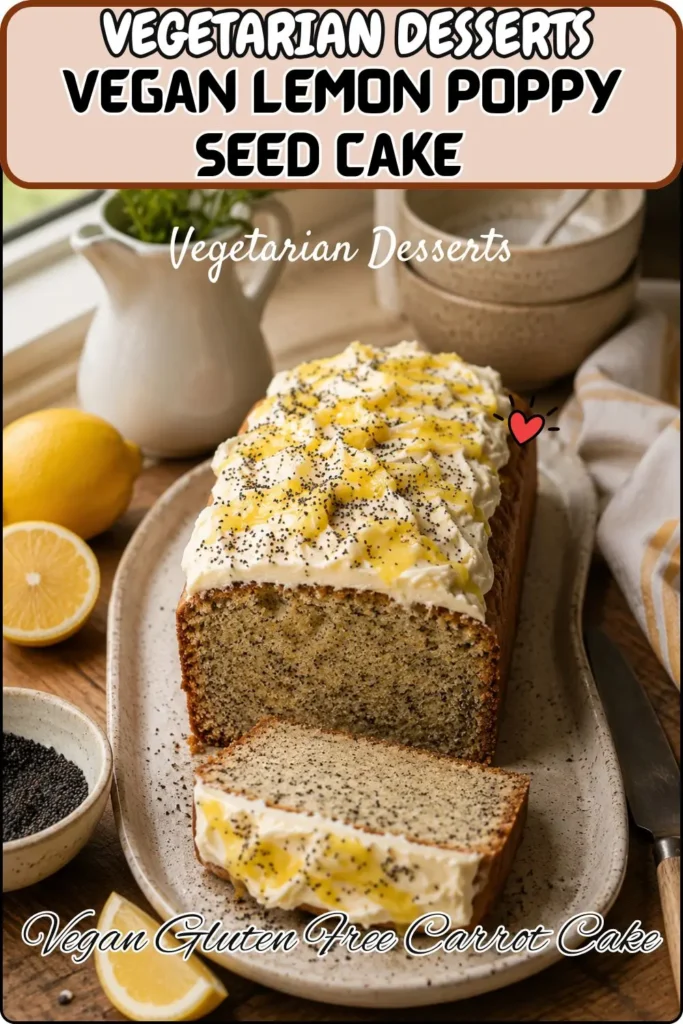
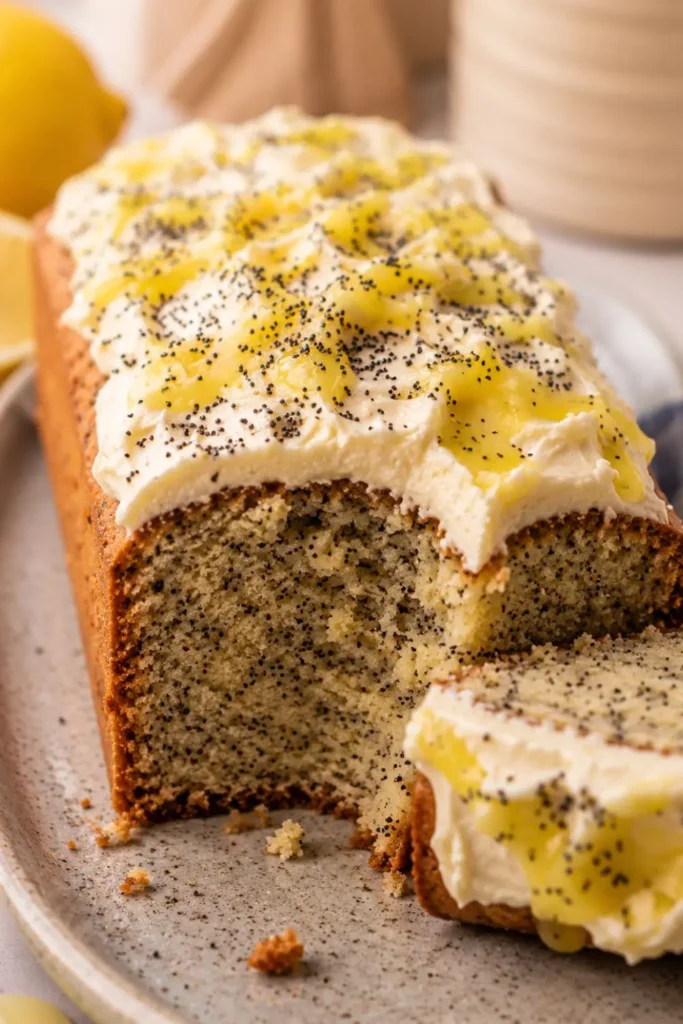
Lemon poppy seed cake occupies a specific place in the baking universe elegant enough for afternoon tea, casual enough for a Tuesday morning slice with coffee, and universally appealing in a way that more polarizing flavors never achieve. Vegan lemon poppy seed cake bakes into a golden, deeply lemon-scented loaf with those characteristic poppy seed specks throughout, topped with a lemon buttercream that adds a creamy, tangy finish and optional swirls of vegan lemon curd that make the whole thing look genuinely restaurant-quality. 10 slices, 366 calories each, completely plant-based.
I make this lemon poppy seed cake recipe whenever I want something that feels thoughtful and special without requiring elaborate technique. The zest-rubbed sugar technique is the one move that distinguishes this from average lemon cakes, and once you understand why it works, you’ll use it in every citrus baked good you make going forward. The loaf format keeps it approachable; the lemon curd swirl on top makes it impressive. That’s a combination worth having in permanent rotation.
My Recipe Timing and Serving Details
Here’s your complete planning overview:
| Detail | Info |
| Prep Time | 15 minutes |
| Bake Time | 55–60 minutes |
| Cooling Time | 10 minutes in pan + wire rack |
| Total Time | ~1 hour 15 minutes + cooling |
| Servings | 10 slices |
| Serving Size | 1 slice |
| Calories Per Slice | 366 kcal |
| Course | Dessert / Afternoon Tea |
| Diet | 100% Vegan |
This vegan lemon poppy seed cake serves 10 people as generous loaf slices. At 366 calories per slice (including the lemon buttercream frosting), each slice is a satisfying, properly portioned dessert. The frosting adds approximately 80–100 calories per slice the base cake without frosting comes in around 270–280 calories per slice, making it one of the lighter options in this cake series.
The Lemon Zest and Sugar Technique Why This Step Makes All the Difference
The first instruction in this recipe rubbing lemon zest into granulated sugar is the technique that makes this lemon poppy seed cake recipe taste significantly more lemon-forward than most versions. Understanding why helps you appreciate what’s happening and encourages you to use this technique in all your future citrus baking.
Lemon zest contains essential oils the intensely aromatic, flavor-concentrated compounds locked inside the tiny oil cells in the lemon’s outer skin. These oils carry the bright, floral, intensely lemony character that makes fresh lemon taste so distinctly citrusy.
When you rub lemon zest into sugar with your fingertips, you physically rupture the oil cells and release those essential oils directly into the sugar crystals. The sugar acts as an absorbent carrier it soaks up the oils and holds them in a dispersible form. The resulting lemon sugar is fragrant, pale yellow, and delivers lemon flavor that distributes through the entire batter rather than sitting on the surface.
Zest simply mixed into wet ingredients without this rubbing step delivers only about 50–60% of the flavor potential. The rubbing step captures essentially all of it. FYI this technique works equally well with any citrus orange, lime, grapefruit in any recipe where you want maximum citrus flavor. It takes 60 seconds and is always worth doing.
Full Ingredient List
A purposeful, lemon-forward lineup:
The Cake:
- 1¼ cups (250g) granulated sugar
- 1 tablespoon packed lemon zest – from 3–4 medium lemons
- 2½ cups (315g) all-purpose plain flour
- 1½ tablespoons (14g) poppy seeds
- 3 teaspoons baking powder
- ⅛ teaspoon salt (optional)
- 1 cup (250g) dairy-free milk – at room temperature
- ½ cup (125g) neutral-flavored oil or light olive oil
- ⅓ cup (80g) lemon juice – from 2–3 medium lemons
- 1 teaspoon vanilla extract (optional)
The Lemon Buttercream:
- ⅓ cup (75g) vegan block butter – at room temperature
- 1½ cups (150g) powdered sugar – or to taste
- 1–2 tablespoons lemon juice – or to taste
Optional Decoration:
- ½ batch vegan lemon curd -for swirling into the frosting
- Additional poppy seeds for sprinkling on top
The lemon juice quantity of ⅓ cup is specifically calibrated and the recipe includes an explicit warning: do not add more lemon juice. This appears because it’s a common instinct more lemon juice sounds like more lemon flavor. It’s not. Excess lemon juice adds acidity that makes the batter too wet and interferes with the flour’s gluten network and the baking powder’s leavening action. The result is a dense, gummy cake that doesn’t rise properly.
If you want more lemon flavor beyond what the recipe produces: add more lemon zest, not more juice. The zest’s essential oils amplify lemon flavor without affecting baking chemistry.
The tablespoon of packed lemon zest requires 3–4 medium lemons start with 3 lemons, zest them all, pack the zest into a tablespoon measure, and add more from additional lemons if needed. The packing matters loosely measured zest gives you significantly less than packed zest.
Equipment You’ll Need For Vegan Lemon Poppy Seed Cake
Primary Equipment
- 8-inch (20cm) loaf pan – the loaf format is specifically chosen for this recipe. Loaf pans concentrate heat on all sides of the batter, producing a deep, even bake and the characteristic tall loaf shape with a golden, slightly cracked top crust. Line the pan with a parchment sling a piece of parchment cut wide enough to overhang both long sides for easy removal.
- Oven preheated to 180°C (355°F)
- Wire cooling rack
Mixing Equipment
- Large mixing bowl – for the zest-sugar rubbing and the full batter assembly. This recipe uses a one-bowl approach after the initial zest-sugar step.
- Whisk – for combining dry ingredients and then incorporating wet ingredients
- Spatula – for the final fold to ensure no flour pockets remain at the bottom of the bowl
For the Frosting
- Stand mixer with paddle attachment or electric hand mixer – for beating the vegan butter until light and fluffy before adding sugar and lemon juice. A well-beaten butter produces fluffier, lighter frosting than manually mixed butter.
- Small bowl – for combining frosting ingredients
Serving Tools
- Small spoon – for creating swirl patterns in the frosting and for dotting and swirling the optional lemon curd
- Fine-mesh sieve (optional) – for dusting additional poppy seeds evenly or for a powdered sugar finish if skipping frosting
- Kitchen scale – gram measurements for this recipe produce the most consistent results
Step-by-Step Instructions For Vegan Lemon Poppy Seed Cake
Step 1 – Preheat and Prepare the Pan
Preheat the oven to 180°C (355°F). Line the loaf pan with a parchment sling the overhang on both long sides allows you to lift the finished cake cleanly from the pan once cooled.
Step 2 – The Zest-Sugar Technique
Add the granulated sugar and packed lemon zest to your large mixing bowl. Use your fingertips to rub them together vigorously for 60 seconds until the sugar takes on a pale yellow color and the mixture smells intensely, freshly lemony. Every time you press the zest against the sugar crystals, you rupture more oil cells.
The rubbed mixture should feel slightly damp and look uniformly pale yellow a clear sign the essential oils have transferred into the sugar.
Step 3 -Add Dry Ingredients
Add the flour, poppy seeds, baking powder, and salt directly to the bowl with the lemon sugar. Whisk together until the mixture is evenly combined and the poppy seeds distribute uniformly through the flour.
Step 4 – Add Wet Ingredients
Add the room temperature dairy-free milk, neutral oil, lemon juice, and vanilla extract to the bowl. Mix until just combined some lumps are acceptable and expected; what you want to eliminate is visible pockets of dry flour at the bottom of the bowl. Reach the spatula all the way to the bottom of the bowl with your final few folds to capture any settled dry ingredients.
Do not overmix. Stop as soon as no visible dry flour remains.
Step 5 – Bake
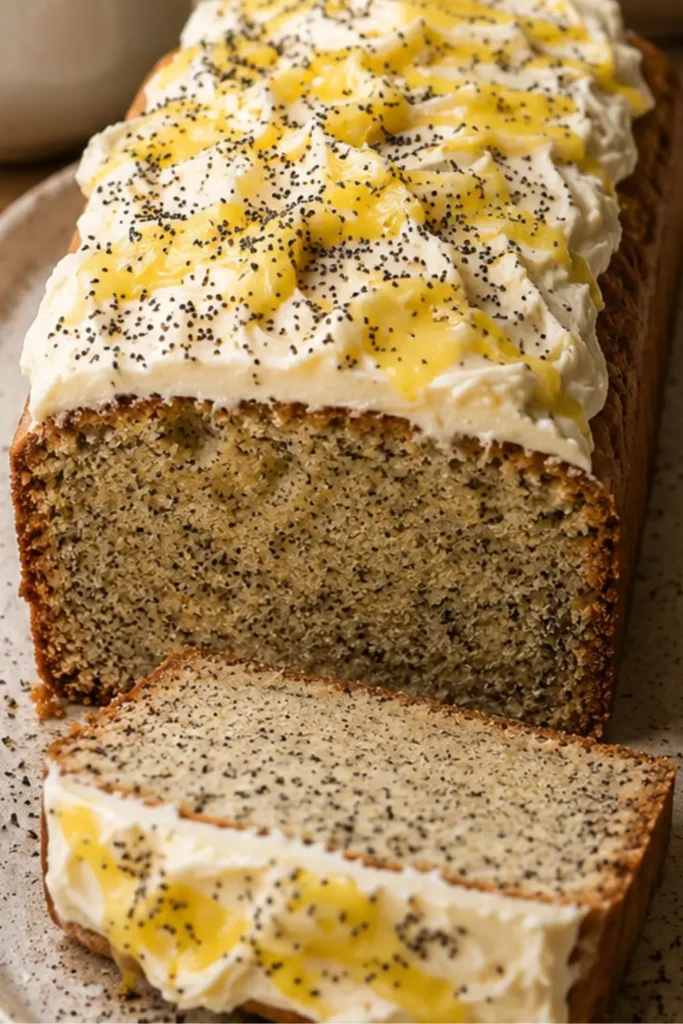
Pour the batter into the prepared loaf pan. Place in the preheated oven and bake for 55–60 minutes until:
- The top is golden brown
- A toothpick inserted into the center comes out with no wet batter (moist crumbs are fine)
- The cake feels firm when gently pressed in the center
If the top browns before the center is done, tent loosely with aluminum foil for the final 10–15 minutes.
Step 6 – Cool
Allow the cake to cool in the loaf pan for 10 minutes, then use the parchment sling to lift it onto a wire rack. Cool completely before frosting. Adding frosting to a warm cake causes it to melt and slide off rather than sitting attractively on the surface.
Step 7 – Make the Lemon Buttercream
Beat the room temperature vegan block butter in your stand mixer or with a hand mixer for 2–3 minutes until light and fluffy. Add the powdered sugar, lemon juice, and vanilla extract and beat until combined and smooth.
Consistency adjustment:
- Too stiff – add lemon juice or dairy-free milk 1 teaspoon at a time
- Too soft – add powdered sugar 2 tablespoons at a time
- Ideal consistency- Spreadable with a spatula, holds soft peaks, doesn’t run when applied
Step 8 – Frost and Decorate
Dollop the lemon buttercream generously on top of the completely cooled cake. Use a small spoon to create swirl patterns a simple back-and-forth motion creates a casual, attractive texture.
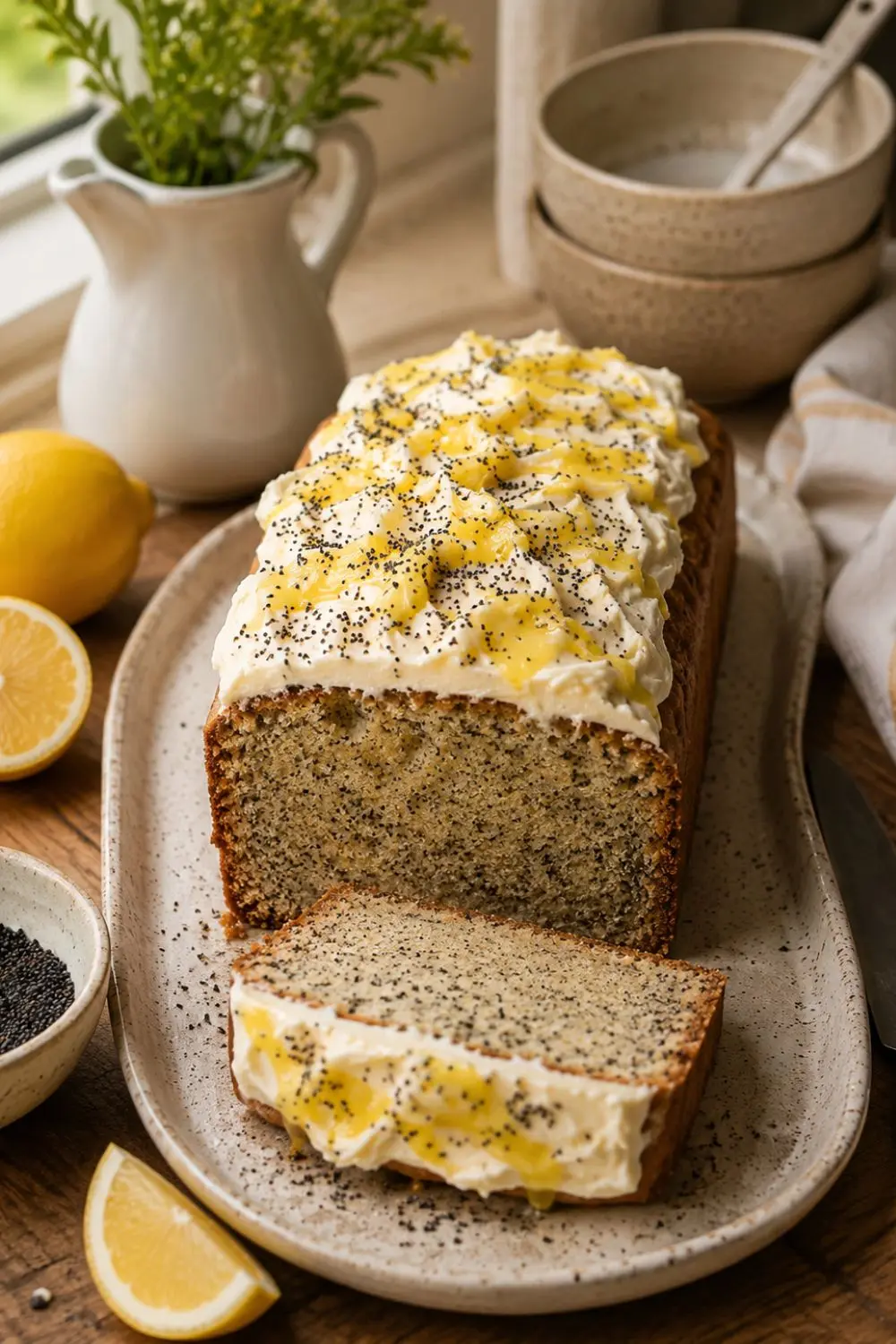
If using the optional vegan lemon curd: dot small amounts across the surface of the frosting, then use the spoon tip to swirl them into the buttercream. The yellow curd against the pale frosting creates a beautiful marbled effect.
Sprinkle additional poppy seeds across the frosted surface for visual completeness.
The Poppy Seed Role More Than Visual
Poppy seeds in cake contribute three specific qualities worth understanding:
Textural contrast- Poppy seeds are small and slightly crunchy they create a subtle textural variation within the tender cake crumb that makes each bite more interesting than a plain crumb would be. The 1½ tablespoons is enough to feel their presence without making the cake feel seedy throughout.
Visual character- The dark blue-grey specks against the pale golden crumb create the characteristic poppy seed cake appearance that signals the flavor immediately. This visual identification is part of why people find this cake appealing before they taste it.
Subtle flavor- Poppy seeds have a mild, nutty, slightly earthy flavor that’s barely detectable in a single seed but creates a background note throughout the slice. It doesn’t compete with the lemon — it complements it the same way sesame seeds complement citrus in Middle Eastern pastries.
The quantity matters- Less than 1 tablespoon creates a visual presence without meaningful taste. More than 2 tablespoons starts to feel like eating poppy seeds with cake rather than lemon cake with poppy seeds. The recipe’s 1½ tablespoons lands in the right place.
Plant-Based Milk Options
The 1 cup of dairy-free milk at room temperature provides the liquid base for the cake. Different milks produce slightly different results:
Oat milk – the closest to whole milk in fat content and natural sweetness. Produces a slightly richer, more tender crumb. Most widely compatible with the lemon flavor. IMO the best choice for this specific recipe.
Soy milk – slightly higher protein creates a slightly firmer crumb. Works excellently and is the most consistent performer across different baking temperatures.
Almond milk -lighter, slightly nutty, very neutral. Works well but the cake is slightly less rich than oat or soy versions.
Room temperature matters- Cold milk can cause the oil in the batter to partially solidify and create an uneven batter that doesn’t mix smoothly. Take the milk out of the refrigerator at least 30 minutes before starting.
The Gluten-Free Version
The recipe’s note for a gluten-free lemon poppy seed layer cake or loaf: King Arthur’s Measure for Measure flour works well as a 1:1 replacement. If using this GF blend, add 5–10 minutes of additional bake time GF flour blends absorb liquid slightly differently and may need more time to bake through completely.
Other GF flour blends may produce different results the recipe acknowledges this honestly. If you use a different blend, check doneness from 55 minutes and continue in 5-minute increments until the toothpick test confirms it’s done.
The Color Question
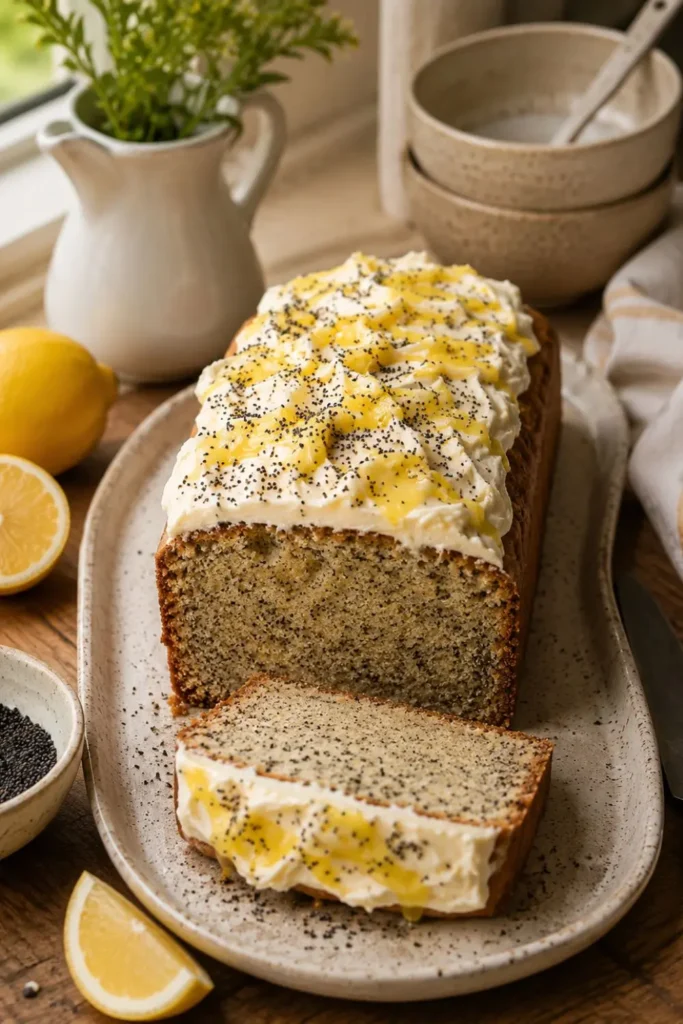
The recipe notes that light olive oil or a few drops of yellow food coloring gives the cake a subtle yellow color appropriate for a vegan lemon poppy seed cake that should look as lemony as it tastes.
Light olive oil contributes its natural yellowish tint through the oil-based liquid component. Extra virgin olive oil has more color but also a more pronounced flavor use your preference.
Yellow food coloring (a few drops) produces the most reliably yellow result. Vegan-certified yellow food dye from Color Kitchen or India Tree works without affecting flavor.
What NOT to use- The recipe specifically warns that turmeric may give your cake a slight green hue the yellow of turmeric reacts with the lemon juice’s acidity and shifts toward green during baking. A surprising result that’s worth avoiding for appearance reasons even though turmeric tastes fine in cake.
Serving Suggestions Beyond the Frosting
The recipe’s Note 3 lists several serving alternatives:
Simple two-ingredient icing- Powdered sugar + lemon juice, whisked to a drizzleable consistency and poured over the cooled cake. Less rich than buttercream, but more visually striking with its glossy, white finish.
Fresh berries- A scattering of fresh raspberries, blueberries, or sliced strawberries alongside each slice for a summery, fruity complement.
Powdered sugar dusting only- The most minimal, elegant finish. Sift powdered sugar through a fine-mesh sieve for an even, beautiful finish that takes 30 seconds.
Vegan lemon curd alongside- A small jar of lemon curd for guests to add to their slice according to preference.
You may also like Next recipe
Nutrition Information Per Slice
At 366 calories per slice for 10 slices (with buttercream frosting):
| Nutrient | Per Slice |
| Calories | 366 kcal |
| Carbohydrates | 56g |
| Protein | 5g |
| Fat | 13g |
| Fiber | 1g |
| Sugar | 33g |
| Sodium | 193mg |
| Calcium | 140mg |
| Vitamin C | 3mg |
| Iron | 2mg |
140mg of calcium per slice is approximately 14% of the daily recommended intake primarily from the fortified dairy-free milk and the lemon juice. At 366 calories per slice including frosting, this is one of the lighter loaf cakes in this series, making a second slice genuinely reasonable for any occasion.
Storage
- Room temperature- Airtight container for 1–2 days
- Refrigerator- Airtight container for 3–4 days bring to room temperature 20 minutes before serving
- Freezer- Frosted cake can be frozen for up to 1 month freeze slices individually, wrapped tightly. Thaw at room temperature.
My Final Thoughts
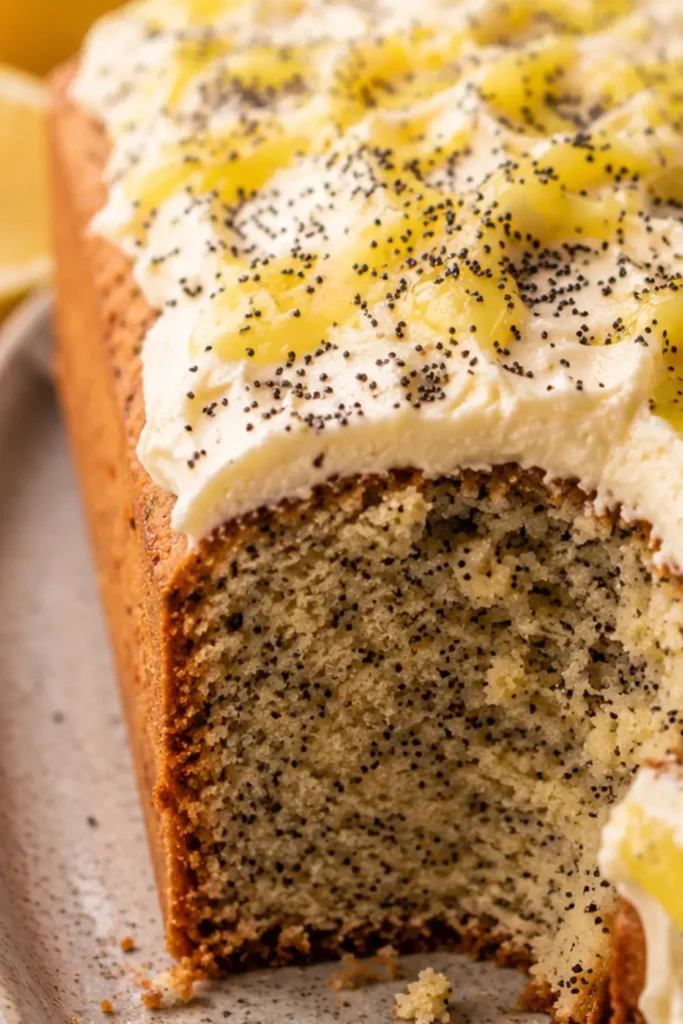
Vegan lemon poppy seed cake is the recipe that makes lemon the unambiguous star of the occasion intensified through the zest-rubbing technique, balanced by the lemon buttercream, accented by the poppy seeds’ subtle texture, and finished with the optional lemon curd swirl that makes every slice look genuinely special.
366 calories per slice, 10 people served, one loaf pan, 15 minutes of prep.
Rub the zest into the sugar. Don’t add extra lemon juice add extra zest instead. Cool completely before frosting. Swirl the lemon curd into the buttercream and sprinkle the poppy seeds on top.
Then cut the first slice, admire the speckled crumb, and eat it with the best coffee or tea you have available. That’s the right way to serve this cake.
Vegan Lemon Poppy Seed Cake
Ingredients
Equipment
Method
- Step 1 – Preheat and Prepare the Pan
- Preheat the oven to 180°C (355°F). Line the loaf pan with a parchment sling the overhang on both long sides allows you to lift the finished cake cleanly from the pan once cooled.
- Step 2 – The Zest-Sugar Technique
- Add the granulated sugar and packed lemon zest to your large mixing bowl. Use your fingertips to rub them together vigorously for 60 seconds until the sugar takes on a pale yellow color and the mixture smells intensely, freshly lemony. Every time you press the zest against the sugar crystals, you rupture more oil cells.
- The rubbed mixture should feel slightly damp and look uniformly pale yellow a clear sign the essential oils have transferred into the sugar.
- Step 3 -Add Dry Ingredients
- Add the flour, poppy seeds, baking powder, and salt directly to the bowl with the lemon sugar. Whisk together until the mixture is evenly combined and the poppy seeds distribute uniformly through the flour.
- Step 4 – Add Wet Ingredients
- Add the room temperature dairy-free milk, neutral oil, lemon juice, and vanilla extract to the bowl. Mix until just combined some lumps are acceptable and expected; what you want to eliminate is visible pockets of dry flour at the bottom of the bowl. Reach the spatula all the way to the bottom of the bowl with your final few folds to capture any settled dry ingredients.
- Do not overmix. Stop as soon as no visible dry flour remains.
- Step 5 – Bake
- Pour the batter into the prepared loaf pan. Place in the preheated oven and bake for 55–60 minutes until:
- The top is golden brown
- A toothpick inserted into the center comes out with no wet batter (moist crumbs are fine)
- The cake feels firm when gently pressed in the center
- If the top browns before the center is done, tent loosely with aluminum foil for the final 10–15 minutes.
- Step 6 – Cool
- Allow the cake to cool in the loaf pan for 10 minutes, then use the parchment sling to lift it onto a wire rack. Cool completely before frosting. Adding frosting to a warm cake causes it to melt and slide off rather than sitting attractively on the surface.
- Step 7 – Make the Lemon Buttercream
- Beat the room temperature vegan block butter in your stand mixer or with a hand mixer for 2–3 minutes until light and fluffy. Add the powdered sugar, lemon juice, and vanilla extract and beat until combined and smooth.
- Consistency adjustment:
- Too stiff – add lemon juice or dairy-free milk 1 teaspoon at a time
- Too soft – add powdered sugar 2 tablespoons at a time
- Ideal consistency- Spreadable with a spatula, holds soft peaks, doesn’t run when applied
- Step 8 – Frost and Decorate
- Dollop the lemon buttercream generously on top of the completely cooled cake. Use a small spoon to create swirl patterns a simple back-and-forth motion creates a casual, attractive texture.
- If using the optional vegan lemon curd: dot small amounts across the surface of the frosting, then use the spoon tip to swirl them into the buttercream. The yellow curd against the pale frosting creates a beautiful marbled effect.
- Sprinkle additional poppy seeds across the frosted surface for visual completeness.
Notes
Nutrition Information Per Slice
At 366 calories per slice for 10 slices (with buttercream frosting):| Nutrient | Per Slice |
| Calories | 366 kcal |
| Carbohydrates | 56g |
| Protein | 5g |
| Fat | 13g |
| Fiber | 1g |
| Sugar | 33g |
| Sodium | 193mg |
| Calcium | 140mg |
| Vitamin C | 3mg |
| Iron | 2mg |

Hi — I’m Rachel. I’m a wife, a mom, and a home cook who believes that food should bring comfort, joy, and compassion to the table. I live with my family — two hungry little foodies who are my most honest recipe testers — and together we’ve built a kitchen culture that’s all about good food that happens to be 100% vegan. I started this blog because I wanted a place to share the recipes that keep our days moving, the dishes that make weeknights feel a little easier, and the meals that become our little family traditions.