
A hummus platter is genuinely the party food format that gives you the most impressive result for the least amount of actual work and I say that as someone who has built elaborate charcuterie boards, spent hours on trifles, and produced complicated appetizer spreads that consumed entire weekend afternoons. Vegan Hummus Platter Ideas: The Easiest Party Board You’ll Ever Make earns that title completely.
Four varieties of hummus, a generous spread of colorful vegetables, some fruit, figs, olives, crackers, and jam arranged on a large board in 20 minutes produces something that looks like you put in considerable effort and costs a fraction of any restaurant equivalent. It serves 20 people at 89 calories per serving. That math is almost unfairly good.
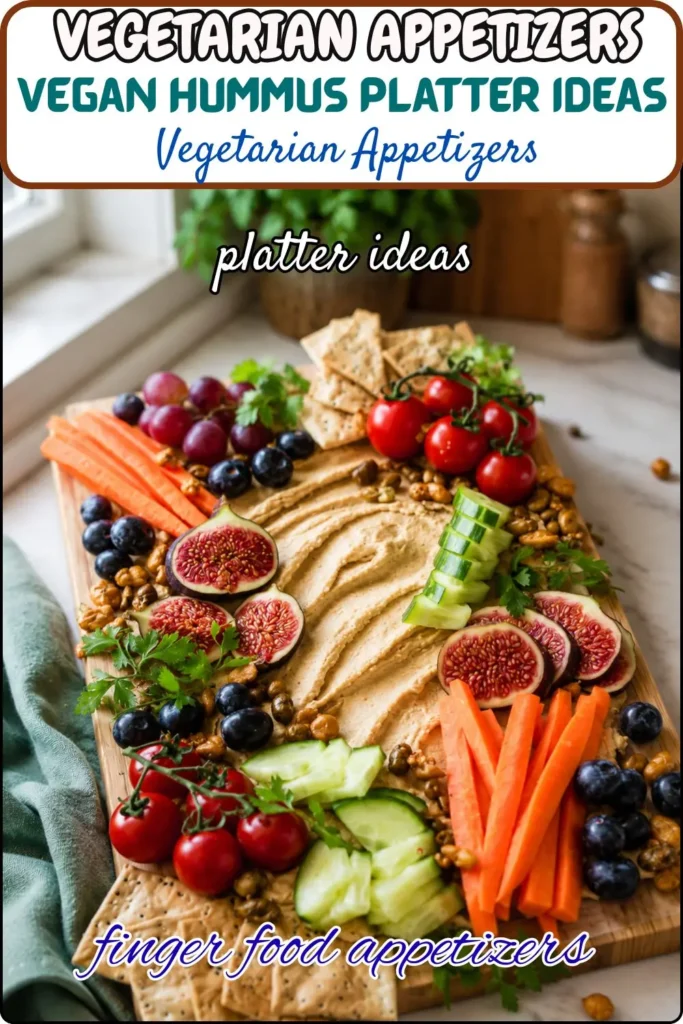
I started building hummus platters for large gatherings specifically because they solve a problem that most party food formats create: dietary restrictions. Every single item on a hummus platter is naturally vegan, naturally gluten-free (except the crackers, easily swapped), and appealing to virtually every guest at any table. Nobody looks at a beautiful hummus board and says “I can’t eat that.” That alone makes this my go-to for mixed-crowd entertaining.
My Recipe Timing and Serving Details
| Detail | Info |
| Prep Time | 20 minutes |
| Cook Time | 0 minutes |
| Total Time | 20 minutes |
| Servings | 20 people |
| Serving Size | Approximate individual portion |
| Calories Per Serving | 89 kcal |
| Course | Appetizer / Party Board |
| Diet | 100% Vegan, Naturally Gluten-Free (without crackers) |
This vegan hummus platter serves 20 people as a party appetizer genuinely one of the most crowd-efficient entertaining formats possible at 89 calories per serving. With 3 grams of protein and 3 grams of fiber per serving from the hummus and vegetables, this is a nutritionally decent appetizer at remarkably light caloric cost. The 20-minute assembly time is accurate and achievable this is specifically a no-cooking, pure-assembly recipe.
The Four-Hummus Strategy Why Variety Transforms the Board
The single decision that elevates a hummus platter from “bowl of dip with vegetables” to a genuinely impressive party board is using four different hummus varieties rather than one. Here’s why this matters beyond just having more food:
Different hummus flavors create different pairing logic throughout the board. Classic hummus pairs with almost everything. Spicy hummus pairs specifically well with cucumber and carrot for cooling contrast. Roasted garlic hummus pairs beautifully with the cherry tomatoes and figs. Roasted red pepper hummus creates a natural visual and flavor connection with the sliced bell peppers.
When you give guests four flavor options, they naturally start building intentional combinations this hummus with this vegetable and this cracker and the board becomes interactive rather than passive. That interaction is what keeps people at the board longer and makes the grazing experience genuinely enjoyable.
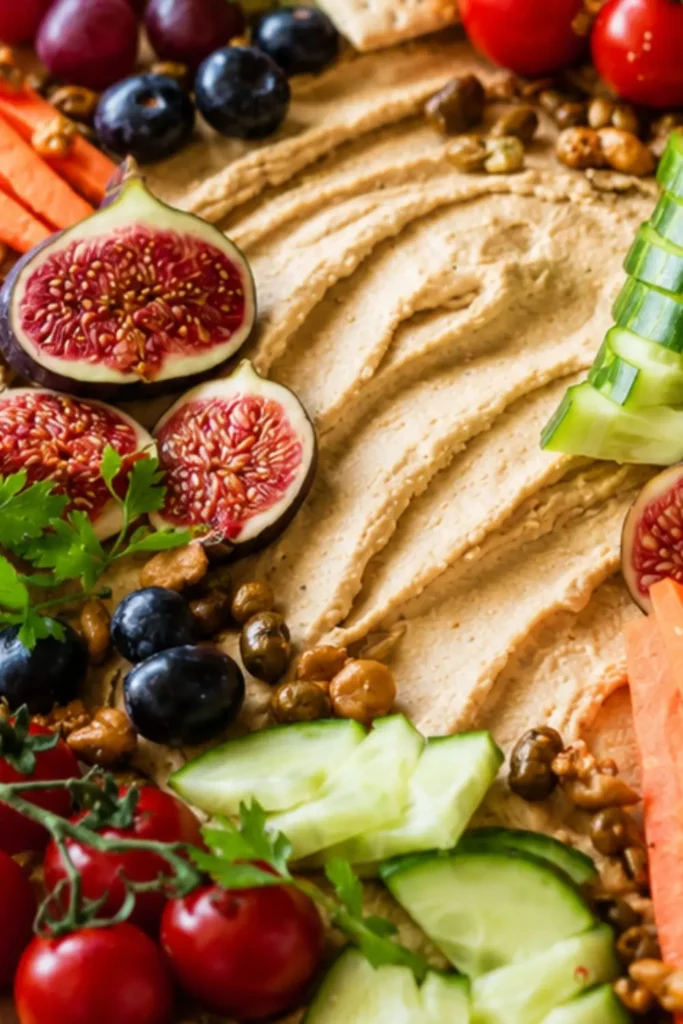
The Four Hummus Varieties
Classic Hummus – the foundation that every guest can use as a default. Smooth, creamy, gently seasoned, and universally compatible with every other component on the board.
Spicy Hummus – provides the heat option that approximately half your guests actively want. Adds the color variation (often darker orange-red) that breaks up visual monotony on the board.
Roasted Garlic Hummus – the most savory, most deeply flavored option. Pairs beautifully with raw vegetables and the figs’ sweetness in a way that surprises people.
Roasted Red Pepper Hummus – the brightest, most visually distinctive option. Its vibrant orange-red color makes it the most photogenic element on the board and its sweet-roasted flavor is genuinely crowd-pleasing.
Homemade vs. Store-Bought The Honest Comparison
This recipe uses a combination of homemade and store-bought and that’s IMO genuinely the right approach for a 20-person party board.
When to make homemade- Classic hummus and roasted red pepper hummus are both easy enough to make at home and taste noticeably better than most store-bought versions. A good food processor, a can of chickpeas, tahini, lemon, and garlic produces classic hummus in 5 minutes. Adding jarred roasted red peppers produces the red pepper version with no additional effort.
When to buy store-bought- Spicy and roasted garlic varieties from quality brands (Ithaca, Hope Foods, Cedar’s) are consistently good and eliminate the need for specialty ingredients. Buying 2 varieties and making 2 produces the ideal balance of quality and efficiency.
FYI elevate any store-bought hummus immediately by drizzling good olive oil over the surface and adding a pinch of smoked paprika and a scattering of toasted pine nuts. This 30-second treatment makes store-bought hummus look and taste significantly better than it does straight from the container.
The Vegetable Selection Color, Crunch, and Flavor Range
The ten vegetables on this board aren’t arbitrary they’re chosen to provide color variety, textural contrast, and flavor range that makes the grazing experience continuously interesting.
The Primary Dipping Vegetables
Bell Peppers (red, yellow, green, sweet — 1 each, sliced) -the most important visual element on the entire board. Four different colored pepper varieties sliced into strips create a rainbow effect that makes the board look genuinely beautiful. Their natural sweetness pairs well with all four hummus varieties.
Snap Peas (6-8) – the bright green element. Crunchy, slightly sweet, and convenient for scooping dip given their natural concave shape. They also hold up beautifully throughout a 2-3 hour party without wilting.
Radishes (2, sliced) – thin, crispy, slightly peppery rounds that add a pale pink-white color and a distinctive crunch that no other vegetable on the board provides. Radishes pair specifically well with roasted garlic hummus.
Cucumber (from the zucchini slot — easily substituted) – if zucchini isn’t your preferred raw vegetable, cucumber slices make an excellent substitution. Sliced on the bias for more elegant pieces.
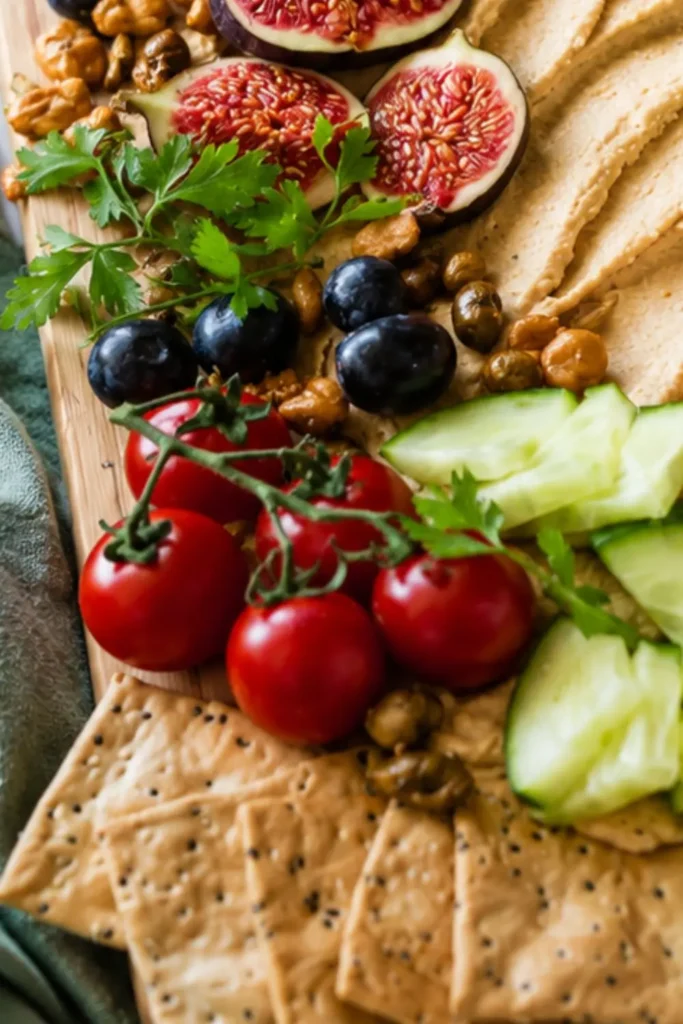
The Flavor-Forward Vegetables
Zucchini (½, sliced into coins) – mild, crisp, and a neutral canvas for any of the four hummus varieties. Sliced into thin coins rather than sticks for easier dipping.
Eggplant (½, sliced into coins) – the most surprising vegetable on the board for guests who haven’t tried raw eggplant with hummus. Young, fresh eggplant has a mild, slightly bitter crunch that pairs well with the roasted red pepper hummus specifically.
Cherry Tomatoes (6-8) -the juicy, sweet element that provides textural variety as the one component that’s not purely crisp. Use mixed colors when available for maximum visual impact.
Jalapeño (1, seeded and sliced) – for heat seekers who want more spice than the spicy hummus already provides. Seeded significantly reduces the heat leave some seeds in for genuine fire, remove all for a milder pepper flavor.
Avocado (1, sliced into strips) – the richest, creamiest vegetable element that creates a completely different textural experience from everything else on the board. Avocado with roasted garlic hummus is a genuinely exceptional combination. Slice and add immediately before serving to prevent browning.
Onion (½, sliced) – raw onion on a hummus board sounds unconventional but works beautifully when sliced thin and placed near the spicy or roasted garlic hummus. Red onion specifically adds beautiful purple color and a milder flavor than yellow onion raw.
The Strategic Vegetable Arrangement
Place vegetables in color groupings rather than randomly scattering everything this creates visual order that makes the board look intentional. Work with the color wheel: green snap peas near the red bell peppers, purple onion near the yellow peppers, pale zucchini coins near the vibrant cherry tomatoes.
The Fruit and Sweet Elements Why Fruit Belongs on a Hummus Board
This is the element that surprises most people when they first encounter it fruit on a hummus board? Absolutely. Here’s why it works:
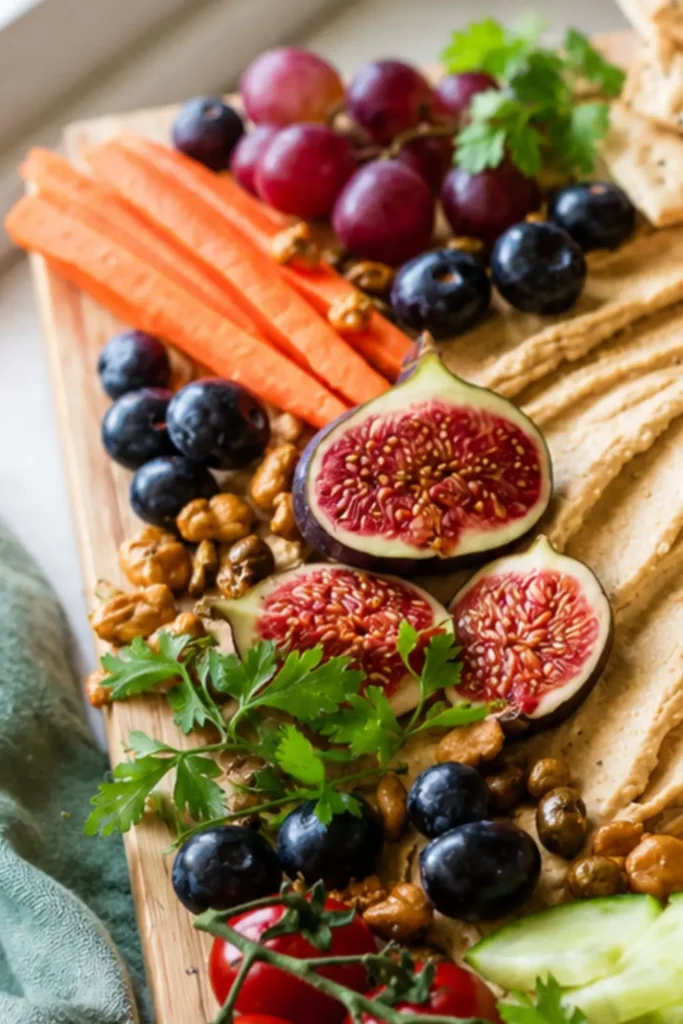
Blueberries (¼ cup) – scattered throughout the board like edible decoration. Their deep blue-purple color creates visual interest throughout the arrangement and their natural sweetness provides a palate-cleansing contrast between savory bites. They pair specifically well with the classic hummus and the crackers.
Figs (4-5, halved) – the most sophisticated element on the board. Fresh figs in season have a honey-like sweetness and an elegant interior when halved that makes them the most visually striking individual items on the platter. They pair beautifully with roasted garlic hummus in a combination that surprises and delights guests. When fresh figs aren’t available, dried figs work well though they’re less visually striking.
The fruit placement strategy- Don’t cluster all fruit together in one area scatter it throughout the board so every section has some color and sweetness to offer. This creates visual flow that draws the eye around the entire platter rather than to one corner.
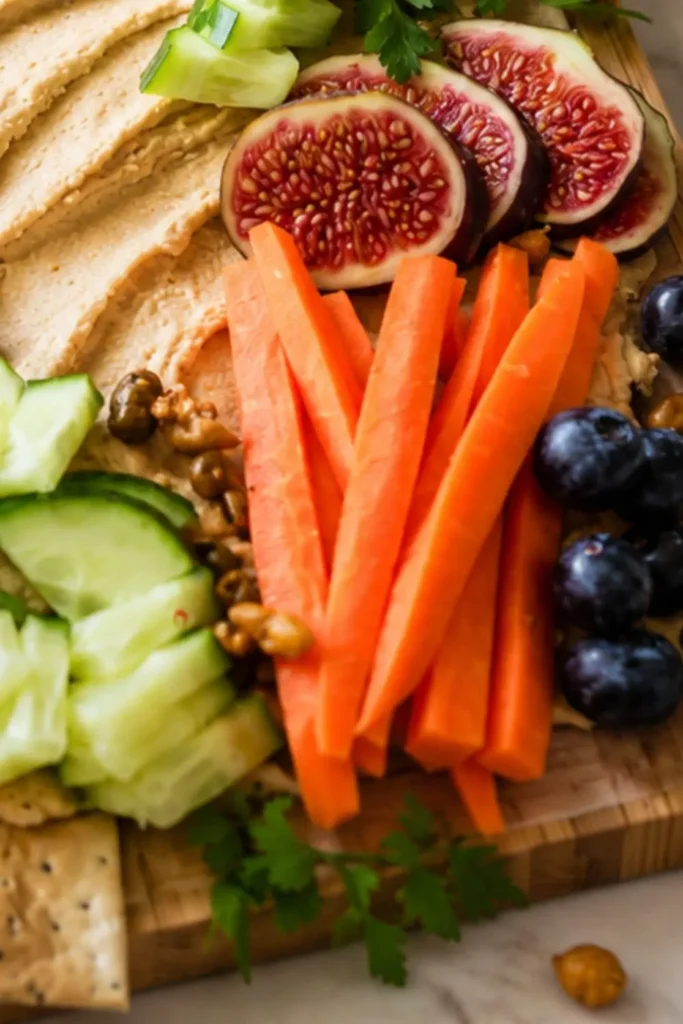
The Finishing Elements Olives, Crackers, and Jam
Olives (¼ cup)
Use mixed olives Kalamata, Castelvetrano, and Cerignola together provide color variety (deep purple, bright green, dark brown) and flavor range (briny, buttery, meaty). Place in a small bowl or pile directly on the board in two or three small clusters throughout the arrangement rather than in a single concentrated pile.
Crackers
Three cracker types for a 20-person board:
- Classic water crackers – neutral, universally compatible with all four hummus varieties
- Multigrain or seeded crackers – more complex flavor, better visual texture
- Crostini or pita chips – for guests who want more substantial dipping vehicles
Place cracker stacks in multiple positions around the board rather than in a single large stack — this makes them accessible from every position around the board and prevents the single-access-point bottleneck that frustrates guests at crowded party tables.
Jam and Spreads
Fig jam – the classic choice for a hummus board. Its sweetness against savory hummus is genuinely extraordinary, and fig jam with crackers and roasted garlic hummus creates a three-component bite that people specifically comment on.
Tart cherry spread – less conventional, genuinely excellent. The sour-sweet cherry flavor creates a different flavor experience from the fig jam and gives guests a second spread option.
Place jams in small individual bowls with small spreading knives. Jams applied directly to a large board area create a sticky mess the small bowl format keeps them contained and accessible.
Equipment You Need For Vegan Hummus Platter Ideas
The Board or Platter – for 20 people, you need significant surface area. A board at minimum 20×24 inches or two large serving platters positioned side by side. A large slate board, a butcher block, or an oversized wooden cutting board all work excellently.
4 Small Bowls or Ramekins – one per hummus variety. This is the core equipment requirement the hummus needs defined containers so it doesn’t run into the vegetables. Small 4-6 oz ramekins work perfectly.
2 Additional Small Bowls – for olives and jam.
Small Serving Spoons -one per hummus bowl, one per jam bowl.
Sharp Knife and Cutting Board – for slicing all the vegetables and fruits. A mandoline slicer produces the most uniform, thin vegetable slices if you own one.
Toothpicks or Appetizer Picks – scattered throughout the board for picking up individual items without fingers.
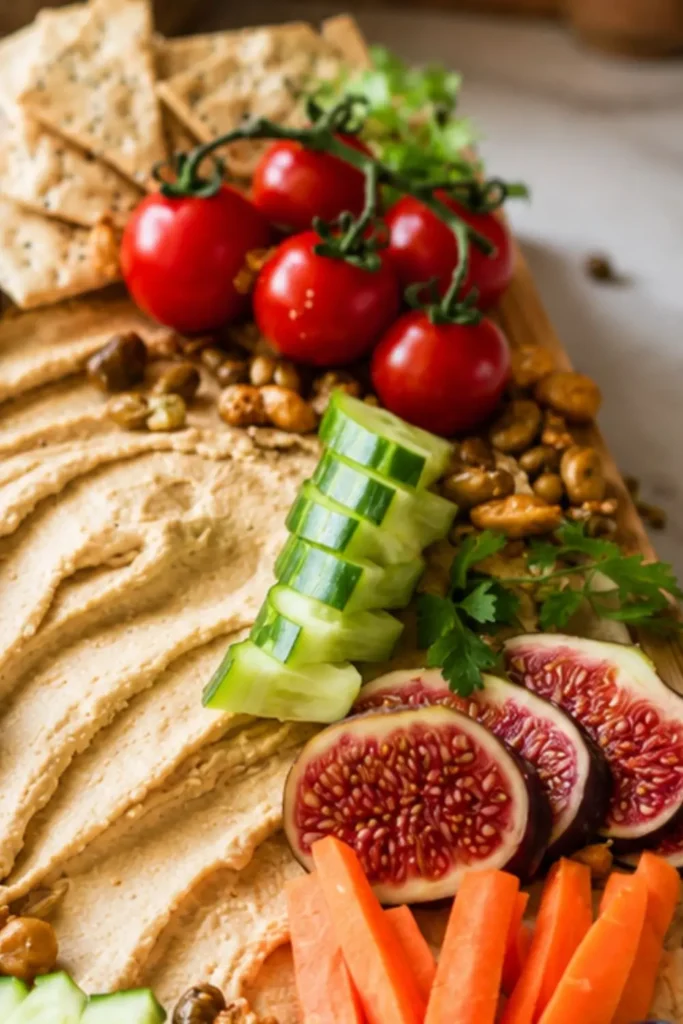
The Assembly Sequence How to Build This Board in 20 Minutes
Minutes 1-5 Place the Hummus Bowls
Position the four hummus-filled bowls first, spread across the board in a rough triangle or square pattern with one in each quadrant. These are your fixed anchor points. Every other component builds outward from them.
Drizzle olive oil over each hummus bowl surface and add a pinch of smoked paprika or za’atar for visual finish.
Minutes 6-12 Slice and Place Vegetables
Slice the peppers, zucchini, eggplant, radishes, avocado, onion, and jalapeño while building — slice each vegetable and place it immediately rather than slicing everything before placing anything.
Fan sliced vegetables in color groups between and around the hummus bowls. Tuck snap peas vertically in groups. Place cherry tomatoes in small clusters.
Minutes 13-17 Add Finishing Elements
Place olive bowl and jam bowls in remaining spaces. Add cracker stacks in multiple positions. Scatter blueberries in gaps throughout the board. Position fig halves cut-side up for visual impact.
Minutes 18-20 Final Touches
Scatter any remaining vegetables to fill gaps. Add fresh herb sprigs (parsley or fresh mint) tucked into any remaining open spaces. A light drizzle of olive oil across the vegetable section adds a professional finishing touch.
You may also like Next recipe
Scaling the Board for Different Party Sizes
| Guests | Hummus | Main Vegetables | Fruit | Crackers |
| 8-10 | 2 varieties (16 oz total) | 5-6 types | Blueberries + 2 figs | 1 variety |
| 12-15 | 3 varieties (24 oz total) | 8 types | Blueberries + 3 figs | 2 varieties |
| 20+ | 4 varieties (32 oz total) | Full list | Full quantity | 3 varieties |
Vegan Hummus Platter Ideas Themed Variations
Mediterranean Theme- Classic + roasted red pepper + tzatziki-style hummus + marinated artichokes + Kalamata olives + pita chips + cucumber + sun-dried tomatoes + fresh mint
Spicy Theme- Spicy hummus + jalapeño hummus + buffalo-style hummus + jalapeños + spicy pepperoncini + corn chips + radishes + celery
Autumn Harvest- Roasted butternut squash hummus + roasted garlic hummus + dried cranberries + apple slices + walnuts + pita chips + rosemary crackers + figs + pomegranate seeds
Spring Fresh- Classic hummus + herb hummus + fresh peas + asparagus tips + radishes + snap peas + lemon-dressed cucumber + fresh mint + edible flowers
Nutrition Information Per Serving
At 89 calories per serving for 20 servings:
| Nutrient | Per Serving |
| Calories | 89 kcal |
| Carbohydrates | 9g |
| Protein | 3g |
| Fat | 5g |
| Fiber | 3g |
| Sugar | 2g |
| Sodium | 157mg |
| Vitamin C | 5mg |
| Potassium | 203mg |
At 89 calories per serving for 20 people, the math on this board is genuinely remarkable for a party food that looks this impressive. The 5 grams of fat per serving comes primarily from the tahini in the hummus and the olive oil on the vegetables predominantly healthy unsaturated fat.
Storage and Make-Ahead Strategy
Day before- Make any homemade hummus varieties. Prepare and store in airtight containers.
2-4 hours before- Slice all vegetables except avocado. Store in separate containers in the refrigerator.
30 minutes before- Assemble the full board except avocado. Cover with plastic wrap and refrigerate.
At serving time- Add freshly sliced avocado (to prevent browning), add crackers (to prevent softening), remove plastic wrap, add herb garnishes.
Board longevity- A hummus platter holds well for 2-3 hours at room temperature in typical indoor party conditions. After 3 hours, the cut vegetables start showing edges and the avocado may begin to discolor.
My Final Thoughts
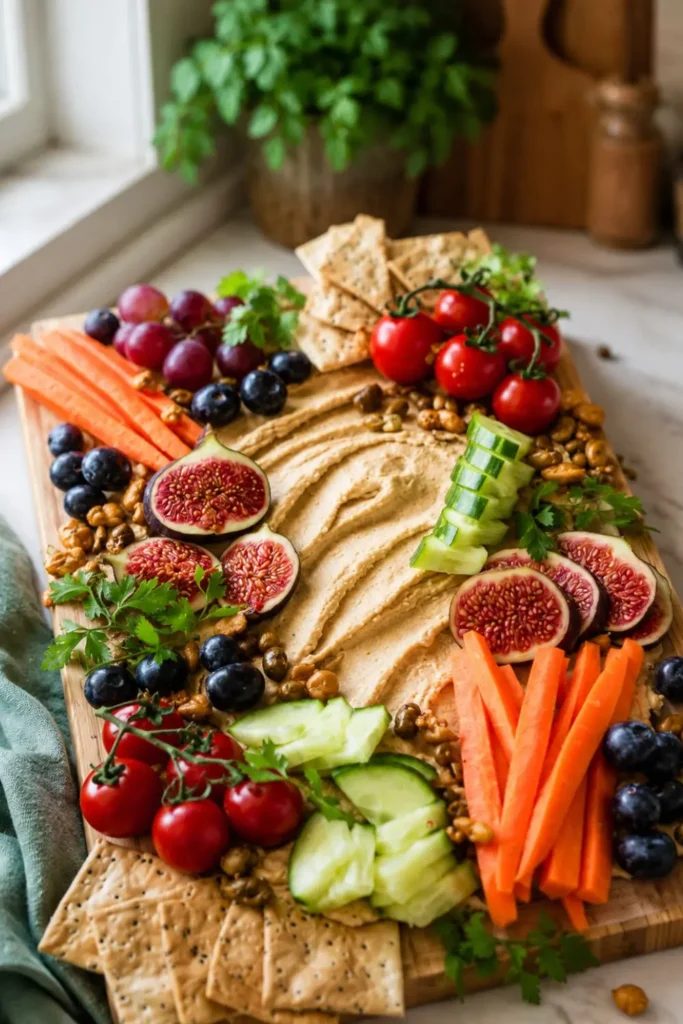
Vegan Hummus Platter Ideas: The Easiest Party Board You’ll Ever Make delivers exactly what that title promises 20 people fed, 20 minutes of prep, 89 calories per serving, completely plant-based, and genuinely beautiful on any party table.
Four hummus varieties. Ten colorful vegetables. Fresh figs and blueberries. Olives, jam, and crackers. A large board and 20 minutes of intentional arrangement.
That’s genuinely the entire formula. Use it the next time you need party food that looks like it required considerably more effort than it did.
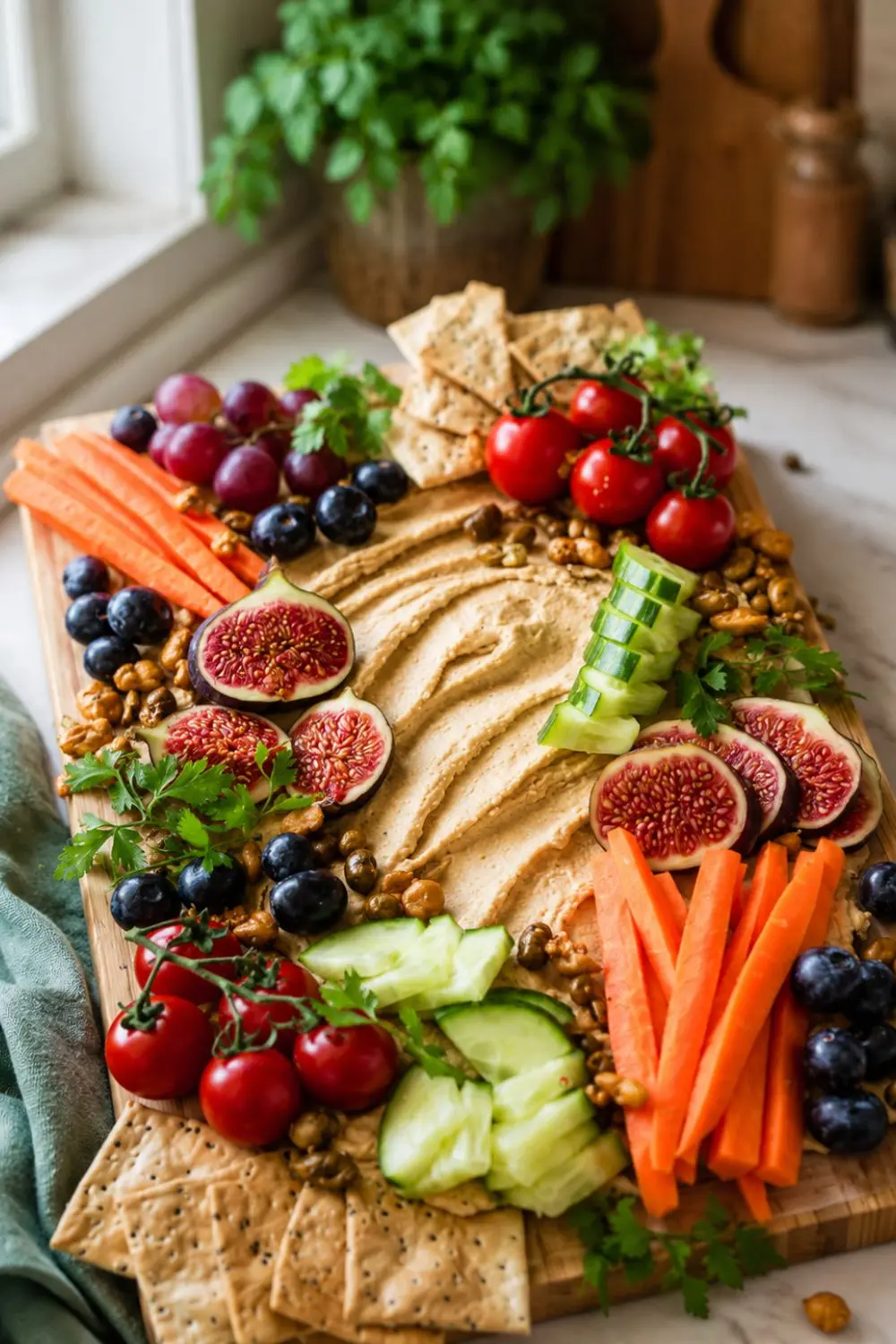
Vegan Hummus Platter Ideas:
Ingredients
Equipment
Method
- Day before- Make any homemade hummus varieties. Prepare and store in airtight containers.
- 2-4 hours before- Slice all vegetables except avocado. Store in separate containers in the refrigerator.
- 30 minutes before- Assemble the full board except avocado. Cover with plastic wrap and refrigerate.
- At serving time- Add freshly sliced avocado (to prevent browning), add crackers (to prevent softening), remove plastic wrap, add herb garnishes.
- Board longevity- A hummus platter holds well for 2-3 hours at room temperature in typical indoor party conditions. After 3 hours, the cut vegetables start showing edges and the avocado may begin to discolor.
- My Final Thoughts
- Vegan Hummus Platter Ideas: The Easiest Party Board You’ll Ever Make delivers exactly what that title promises 20 people fed, 20 minutes of prep, 89 calories per serving, completely plant-based, and genuinely beautiful on any party table.
- Four hummus varieties. Ten colorful vegetables. Fresh figs and blueberries. Olives, jam, and crackers. A large board and 20 minutes of intentional arrangement.
- That’s genuinely the entire formula. Use it the next time you need party food that looks like it required considerably more effort than it did.
Notes
Nutrition Information Per Serving
At 89 calories per serving for 20 servings:| Nutrient | Per Serving |
| Calories | 89 kcal |
| Carbohydrates | 9g |
| Protein | 3g |
| Fat | 5g |
| Fiber | 3g |
| Sugar | 2g |
| Sodium | 157mg |
| Vitamin C | 5mg |
| Potassium | 203mg |

Hi — I’m Rachel. I’m a wife, a mom, and a home cook who believes that food should bring comfort, joy, and compassion to the table. I live with my family — two hungry little foodies who are my most honest recipe testers — and together we’ve built a kitchen culture that’s all about good food that happens to be 100% vegan. I started this blog because I wanted a place to share the recipes that keep our days moving, the dishes that make weeknights feel a little easier, and the meals that become our little family traditions.