Go Back
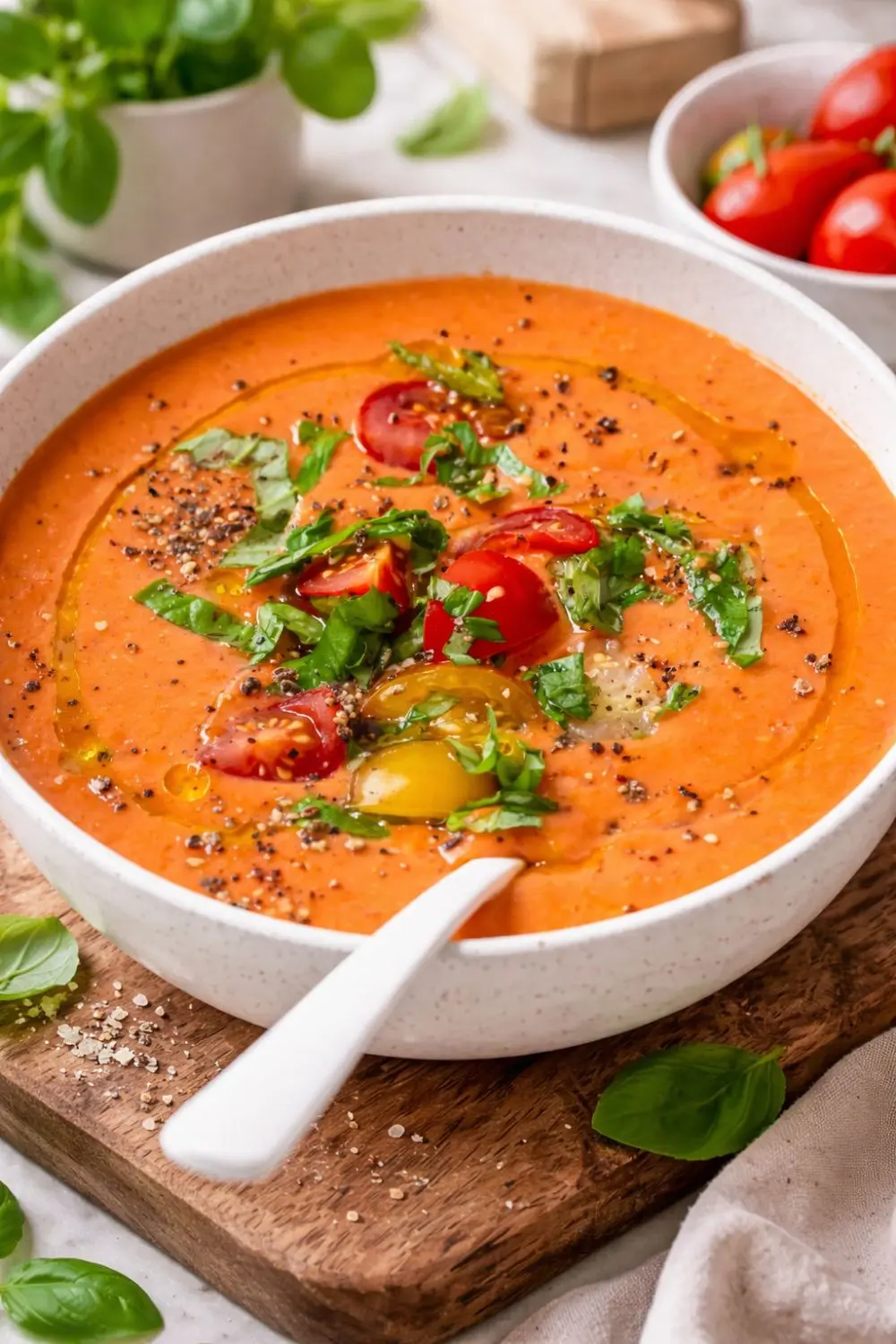
Easy Vegan Gazpacho Recipe

Easy Vegan Gazpacho Recipe

Picture this. It's mid-July, it's 95°F outside, and the absolute last thing you want to do is stand over a hot stove. But you also need to eat something real — something with actual vegetables and flavor — because a bowl of cereal at 7pm is a form of giving up.
Prep Time 20 minutes
Total Time 20 minutes
Servings: 6
Course: Soup
Cuisine: American
Calories: 122

Ingredients
  

  • The Vegetable Base
  • 2 lbs vine tomatoes about 6 tomatoes, chopped — Vine tomatoes are non-negotiable for the best gazpacho. They're riper, sweeter, and more intensely flavored than standard grocery store tomatoes. Roma tomatoes work as a backup. Watery, flavorless hothouse tomatoes will produce watery, flavorless gazpacho — the quality of your tomatoes is the single most important variable in this recipe.
  • ½ cucumber chopped — Adds freshness, water content, and a cool, mild flavor that balances the acidity of the tomatoes. English cucumber works best because it has fewer seeds and thinner skin. Regular cucumber is fine too — just peel it first.
  • 1 red pepper chopped — Red pepper brings sweetness, vitamin C, and a gorgeous deep flavor that green pepper can't match. It also contributes to that beautiful, rich orange-red color. Don't substitute green — the flavor is too sharp and bitter.
  • 1 shallot finely chopped — Milder and more nuanced than white or yellow onion, shallot adds savory depth without overwhelming the delicate tomato and pepper base. If you're out of shallots, ¼ of a small red onion makes a reasonable substitute.
  • 2 cloves garlic finely chopped — Raw garlic in a blended cold soup carries significant punch. Two cloves is the right balance — enough to taste clearly without bulldozing everything else. If you're sensitive to raw garlic, start with one clove.
  • The Dressing
  • ¼ cup 60ml extra virgin olive oil — Use the best olive oil you own. In a recipe this simple and raw, the quality of your olive oil shows directly in the finished flavor. Fruity, peppery extra virgin olive oil adds richness and complexity that makes gazpacho taste luxurious rather than just "blended vegetables."
  • 2 tbsp 30ml lemon juice — The acid that brightens everything and makes the tomato flavor pop. Fresh lemon juice every time — bottled juice has a dull, flat quality that drags down a recipe this fresh-forward. Squeeze it yourself.
  • 1 tsp sea salt — Season properly. Under-salted gazpacho tastes flat and lacks dimension. Start with a teaspoon and adjust after blending.
  • ¼ tsp black pepper — Just enough background warmth. Freshly ground if you have it.
  • The Garnish
  • ¼ cup fresh basil chopped — Don't use dried basil here. Fresh basil added at serving brings a fragrant, slightly sweet herbal note that makes every bowl feel finished and intentional. Sprinkle it on right before eating, not before — it wilts and darkens if added too early.

Equipment

  • Large bowl with ice water — For the ice bath after blanching. Any large mixing bowl works.
  • Slotted spoon — For transferring tomatoes from boiling water to ice bath cleanly.
  • Sharp paring knife — For scoring the tomatoes and peeling back the skins.
  • Large mixing bowl — For combining all the vegetables and letting them marinate together for at least 20 minutes before blending.
  • High-powered blender — This is the most important piece of equipment in the recipe. A Vitamix or Blendtec produces the silkiest, most restaurant-quality result. A regular countertop blender works fine but may need two batches. An immersion blender works in a pinch but produces a slightly chunkier texture.
  • Cutting board and sharp chef's knife — For chopping all your vegetables. Good knife prep makes everything faster.
  • Airtight storage container or pitcher — For chilling the gazpacho for those essential 2 hours (or overnight — more on that later).
  • Fine-mesh strainer (optional) — If you want an ultra-silky, restaurant-smooth texture, strain the blended soup once before chilling. Totally optional but genuinely worth it for special occasions.

Method
 

  1. Making gazpacho is genuinely simple, but the details matter. Here's exactly how to do it right.
  2. Step 1: Blanch and Peel the Tomatoes
  3. This step intimidates people who've never done it, but it takes less than 5 minutes and makes a real textural difference in the finished soup.
  4. Fill a large bowl with ice water and set it near your stove. Bring a large pot of water to a rolling boil.
  5. Score the tomatoes by slicing a small "X" into the bottom of each one with your paring knife — just through the skin, not deep into the flesh. This gives the skin a starting point to peel away easily after blanching.
  6. Drop the tomatoes into the boiling water for exactly 30 seconds. Watch them. At 30 seconds, the scored skin starts to curl back slightly at the X. That's your cue.
  7. Remove with a slotted spoon and drop immediately into the ice water for 1–2 minutes. The shock stops the cooking instantly and makes the skins slide off almost effortlessly.
  8. Peel back the skins starting at the scored X. They should come away in large, clean pieces. Discard the skins. Chop the peeled tomatoes into rough chunks — they don't need to be perfect since they're going into the blender.
  9. Step 2: Combine and Marinate
  10. In a large mixing bowl, combine your chopped tomatoes, cucumber, red pepper, shallot, garlic, olive oil, lemon juice, sea salt, and pepper.
  11. Now here's the step most people skip and then wonder why their gazpacho tastes a little flat: let everything sit together for at least 20 minutes before blending. Stir occasionally. During this marinating window, the salt draws moisture from the vegetables, the olive oil begins to infuse, and the garlic and shallot mellow slightly into the tomato base.
  12. The longer you wait, the better it tastes. If you have time, let it sit for an hour. If you have even more time — refrigerate it overnight before blending. I've done this when prepping for a dinner party and the depth of flavor is noticeably better.
  13. Step 3: Blend Until Smooth
  14. Transfer the marinated vegetables and all their liquid to your blender. If you're using a standard blender rather than a high-powered one, work in two batches to avoid overflow.
  15. Blend on high for at least 60 seconds — longer than you think you need. You want a completely smooth, velvety consistency with no visible chunks. In a Vitamix, 60–90 seconds on high produces a silky, restaurant-quality texture. In a regular blender, run it for 2 full minutes and check the consistency.
  16. Taste the blended soup and adjust seasoning. Add more salt if it tastes flat, more lemon if it needs brightness, more olive oil if it needs richness. This is your last easy opportunity to get the seasoning exactly right before it goes cold.
  17. Step 4: Chill for at Least 2 Hours
  18. Transfer the blended gazpacho to an airtight container or pitcher and refrigerate for a minimum of 2 hours. This step is not optional — warm gazpacho is not really gazpacho. The chill time allows all the flavors to meld and develop, and transforms the soup from "blended vegetables" to something that genuinely tastes complex and complete.
  19. Overnight chilling is even better. I almost always make gazpacho the evening before I want to serve it, and it's consistently the best version.
  20. Step 5: Serve and Garnish
  21. Give the gazpacho a good stir before serving — it separates slightly in the fridge, which is completely normal and expected. Ladle into bowls, sprinkle generously with fresh chopped basil, and serve immediately.
  22. That's it. That's the whole recipe.

Notes

Full Nutrition Breakdown — Per Serving (1 of 6)

Gazpacho is one of those rare dishes where nutritious and deeply satisfying aren't in competition. Here's what every bowl delivers:
Nutrient
Per Serving
Calories
122 kcal
Carbohydrates
9g
Protein
2g
Total Fat
9g
Saturated Fat
1g
Dietary Fiber
3g
Sugar
6g (naturally occurring)
Sodium
397mg
Potassium
448mg
Vitamin A
1,951 IU
Vitamin C
50mg
Calcium
22mg
Iron
1mg
A few things worth highlighting:
  • 50mg of vitamin C per serving covers over 55% of the daily recommended intake in a single bowl. The combination of raw tomatoes, red pepper, and lemon juice makes this one of the highest vitamin C recipes you can eat in summer.
  • 1,951 IU of vitamin A — almost entirely from the tomatoes and red pepper — supports eye health, immune function, and skin health. Raw vegetables preserve this vitamin better than cooked ones.
  • At just 122 calories, this is one of the most nutritionally dense, low-calorie meals in existence. It fits comfortably as a light lunch or a first course before a heartier dinner.
  • The 9g of healthy fat comes almost entirely from the olive oil — predominantly monounsaturated oleic acid, which helps your body absorb the fat-soluble vitamins in the vegetables. The fat in this recipe isn't just for flavor; it makes the entire soup more nutritious.
This recipe serves 6 people generously as a first course, or 4 people as a satisfying light lunch with crusty bread on the side.