
Cold noodles sound like they shouldn’t be this good, and then you try a properly made sesame peanut sauce and suddenly every summer meal plan gets reconsidered. Cold Sesame Peanut Noodles with Crunchy Veggies are among the genuinely best no-cook summer meals in the sense that matters once the noodles are cooked and chilled, the entire dish requires zero heat. The sauce combines peanut butter, tahini, soy sauce, chili garlic sauce, fresh ginger, and garlic into something that tastes deeply savory, slightly spicy, and rich enough to coat every noodle strand. Tossed with matchstick bell pepper, carrot, cucumber, and scallions, then topped with sesame seeds 512 calories per serving, 4 servings, and a dish that most people ask for again within the same week.

I started making this specifically for summer because it requires the stove only for the noodles (15 minutes), and the rest happens in a single bowl with a whisk. The one-hour chill time is genuinely the most effort-intensive part of the recipe which is to say, the refrigerator does all the work. That’s the right ratio of effort to reward for any summer meal.
My Recipe Timing and Serving Details
| Detail | Info |
| Noodle Cook Time | 15 minutes |
| Noodle Chill Time | 1 hour |
| Active Prep (sauce + veg) | 15 minutes |
| Total Time | 1 hour 15 minutes |
| Active Kitchen Time | ~30 minutes |
| Servings | 4 |
| Calories Per Serving | 512 kcal |
| Course | Main Dish |
| Diet | 100% Vegan |
These Cold Sesame Peanut Noodles serve 4 people as a complete main course. At 512 calories per serving with 12 grams of protein, 4 grams of fiber, and 3629 IU of Vitamin A, this is a genuinely filling meal that works hot days when cooking feels like too much commitment but your stomach still needs a real meal.
Why Cold Noodles Need the 1-Hour Chill Not Optional
Most recipe instructions say things like “chill for one hour” and then whisper “or just serve it now, it’ll be fine.” This recipe is not one of those situations the one-hour chill is genuinely doing something important:
The sesame oil coating prevents clumping. After draining, tossing hot noodles with 2 tablespoons of sesame oil coats every strand with oil, preventing them from sticking together during the chill period. Cold, un-oiled noodles become a single dense mass that no amount of tossing with sauce will fully separate.
Cold noodles specifically absorb the peanut sauce differently. Room temperature or warm noodles are softer and more porous they absorb sauce quickly but can become soggy. Chilled noodles have firmer starch structures that coat with sauce rather than absorbing it, creating a dish where the sauce stays on the surface rather than disappearing into the noodle.
The texture contrast only works with cold noodles. The whole point of the crunchy vegetable matchsticks is the contrast between their crisp snap and the cold, sauced noodles. Warm noodles next to cold vegetables creates a confusing temperature and texture experience. Cold noodles alongside cold vegetables creates the specific textural harmony that makes this dish work.
Plan around the chill time- Cook the noodles, toss with sesame oil, cover and refrigerate then do something else for an hour. When you come back, 10 minutes of sauce-making and vegetable-cutting produces dinner.
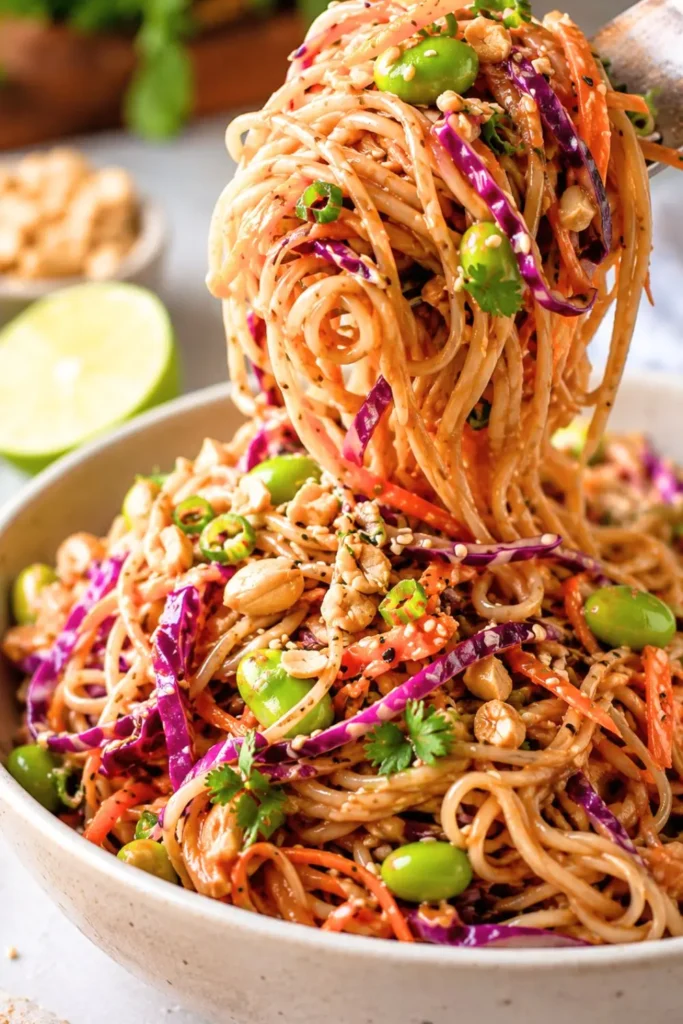
The Noodle Choice Lo Mein Specifically
The recipe calls for lo mein noodles specifically, and this choice affects the finished dish significantly:
Lo Mein Noodles The Right Choice
Lo mein noodles are wheat-based, medium-thick, and round in cross-section they have enough heft to hold up to a thick peanut sauce without becoming overwhelmed. Their surface texture holds sauce well without being too sticky. They’re sold dried or fresh in Asian grocery stores and increasingly in mainstream grocery stores in the Asian foods section.
Fresh lo mein noodles cook in 2-3 minutes and produce a slightly more tender, more authentic result. Find them refrigerated in Asian grocery stores.
Dried lo mein noodles cook in 5-8 minutes and produce a very similar finished result. More widely available and have a longer shelf life.
Substitutions That Work
Spaghetti – the most accessible substitute. Round cross-section like lo mein, similar thickness. Works very well with this sauce.
Linguine – flat cross-section that holds sauce differently. Still works but has a slightly different texture.
Rice noodles – for a gluten-free version. Use medium-thick rice noodles and follow package directions carefully since they typically soak rather than boil. The finished dish is lighter and slightly less substantial.
Soba noodles – buckwheat noodles that add a slightly nutty flavor. Cook al dente since they continue softening after draining. FYI soba noodles are often made with wheat alongside buckwheat; check labels for certified GF versions if needed.
The Al Dente Requirement
Cook the lo mein to al dente specifically tender with a slight firmness at the center. Overcooked lo mein becomes mushy after the one-hour chill, and mushiness combined with thick peanut sauce creates an unpleasant, heavy texture. Al dente noodles maintain their firmness through the chill and sauce-tossing stages.
Full Ingredient List
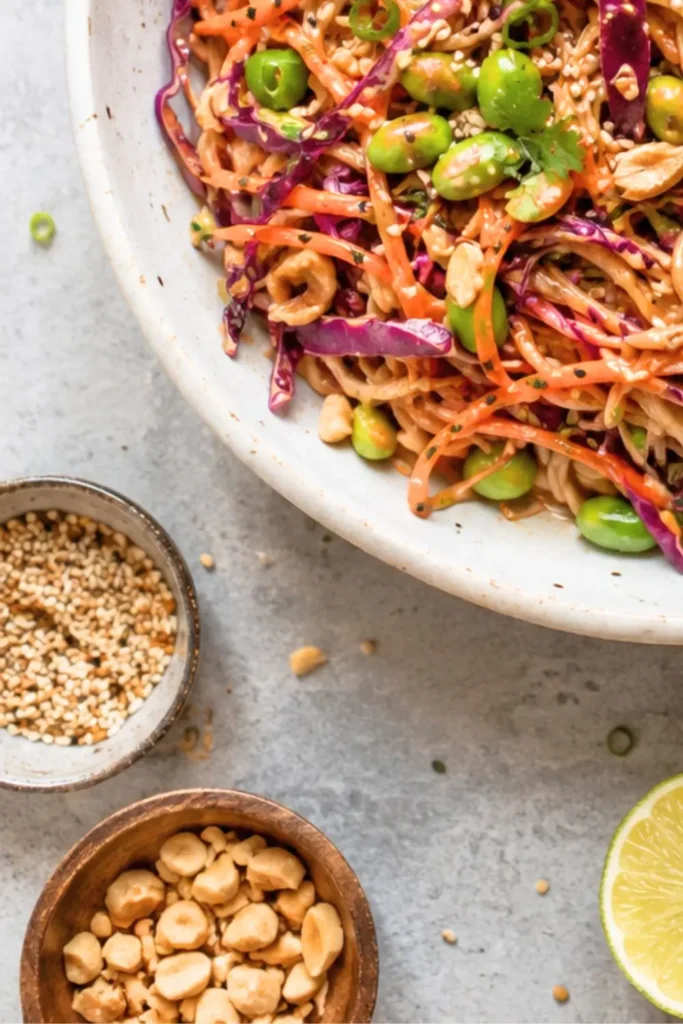
The Noodles:
- 12 oz lo mein noodles
- 2 tablespoons sesame oil – for tossing after cooking
The Vegetables:
- 4 scallions – sliced
- 1 medium red bell pepper – thin matchsticks
- 1 large carrot – thin matchsticks
- ½ medium cucumber – peeled, thin matchsticks
- 1 tablespoon toasted or black sesame seeds – for garnish
The Sesame Peanut Sauce:
- 3 tablespoons low-sodium soy sauce
- 2 tablespoons peanut butter
- 1 tablespoon raw tahini
- 1 tablespoon rice vinegar
- 1 tablespoon sesame oil
- 1 tablespoon brown sugar
- 1 tablespoon chili garlic sauce
- 1 teaspoon freshly grated ginger root
- 2 cloves garlic, grated
Equipment You’ll Need For Cold Sesame Peanut Noodles with Crunchy Veggies
Primary Equipment
Microplane grater specifically listed as recipe equipment, and genuinely useful for two sauce components:
The garlic needs to be grated rather than minced for this sauce. Grated garlic releases allicin more completely than minced garlic, producing a more intense, evenly distributed garlic flavor throughout the sauce. Minced garlic produces small chunks that distribute unevenly.
The fresh ginger root also benefits from grating a microplane creates a fine ginger pulp that incorporates completely into the sauce. Minced ginger can leave stringy fibers that create unpleasant textural moments in the noodles.
A fine-toothed box grater works as a microplane substitute for both ginger and garlic if you don’t own a microplane.
Cooking Equipment
- Large pot – for cooking the lo mein noodles
- Colander – for draining
Mixing Equipment
- Large bowl – for tossing the noodles with sesame oil and for the final assembly
- Medium bowl – for whisking the sauce ingredients
- Whisk – for the sauce
Vegetable Prep
- Sharp knife and cutting board – for the matchstick cutting
- Vegetable peeler – for the cucumber
The Sesame Peanut Sauce Understanding Each Ingredient
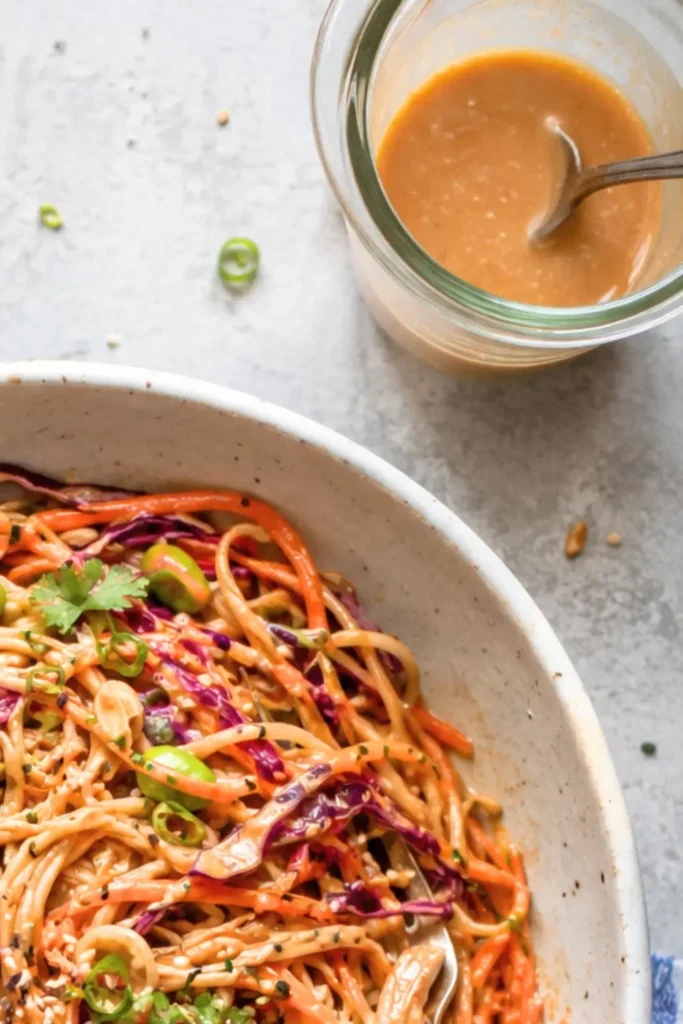
The sauce is the recipe’s central achievement, and understanding what each component contributes explains why this particular combination tastes so good:
Peanut Butter (2 tablespoons) + Tahini (1 tablespoon) The Double-Nut Base
Peanut butter provides the primary richness and that familiar peanut character. Creamy peanut butter specifically not natural peanut butter straight from the jar creates a smoother sauce consistency.
Tahini is the addition that most home cooks skip and shouldn’t. Raw tahini (sesame paste) adds a deeper, slightly bitter nuttiness that makes the sauce taste more complex than peanut butter alone. The “raw tahini” specification refers to unhulled sesame paste, which has a stronger flavor than hulled tahini. Either works in this recipe, though raw/unhulled produces the more assertive result.
Soy Sauce (3 tablespoons) The Umami Foundation
Low-sodium soy sauce is specified to control the final dish’s sodium level. The sauce already contains enough salt for proper seasoning full-sodium soy sauce pushes it into too-salty territory for most palates.
Tamari works as a gluten-free substitute with nearly identical flavor.
Coconut aminos provides a slightly sweeter, less salty alternative for those avoiding soy.
Chili Garlic Sauce (1 tablespoon) The Heat and Complexity
Chili garlic sauce (the Huy Fong or Lan Chi variety) adds heat, garlic, and fermented complexity simultaneously it’s doing three flavor jobs in one tablespoon. It’s not interchangeable with Sriracha (which adds only heat and sweetness) or with gochujang (which adds fermented depth but different heat character).
Adjusting heat- 1 tablespoon produces a moderate heat that most adults enjoy. Reduce to 2 teaspoons for mild heat; increase to 1.5 tablespoons for more assertive spice.
Rice Vinegar (1 tablespoon) + Brown Sugar (1 tablespoon) The Sweet-Acid Balance
Rice vinegar adds brightness and acidity that cuts through the richness of peanut butter and sesame oil. Without it, the sauce tastes heavy and flat.
Brown sugar balances the vinegar’s sharpness and the soy sauce’s saltiness. The molasses in brown sugar adds a subtle caramel depth white sugar works but produces a slightly flatter result.
Sesame Oil (1 tablespoon) The Aromatic Finisher
Sesame oil in the sauce is separate from the sesame oil used to toss the cooked noodles. In the sauce, it adds the characteristic toasted sesame fragrance that defines the entire dish’s character. Use toasted sesame oil (dark brown, intensely aromatic) rather than light sesame oil the flavor difference is significant.
Fresh Ginger (1 teaspoon grated) + Fresh Garlic (2 cloves grated) The Aromatic Backbone
Both must be fresh rather than powdered for this recipe. Fresh ginger provides a warming, slightly spicy, floral quality that dried ginger completely fails to replicate. Fresh garlic provides pungent allicin that powdered garlic substitutes poorly. These two components are specifically what make the sauce taste genuinely “fresh” rather than like a bottled sauce.
The Matchstick Vegetable Technique Why the Cut Matters
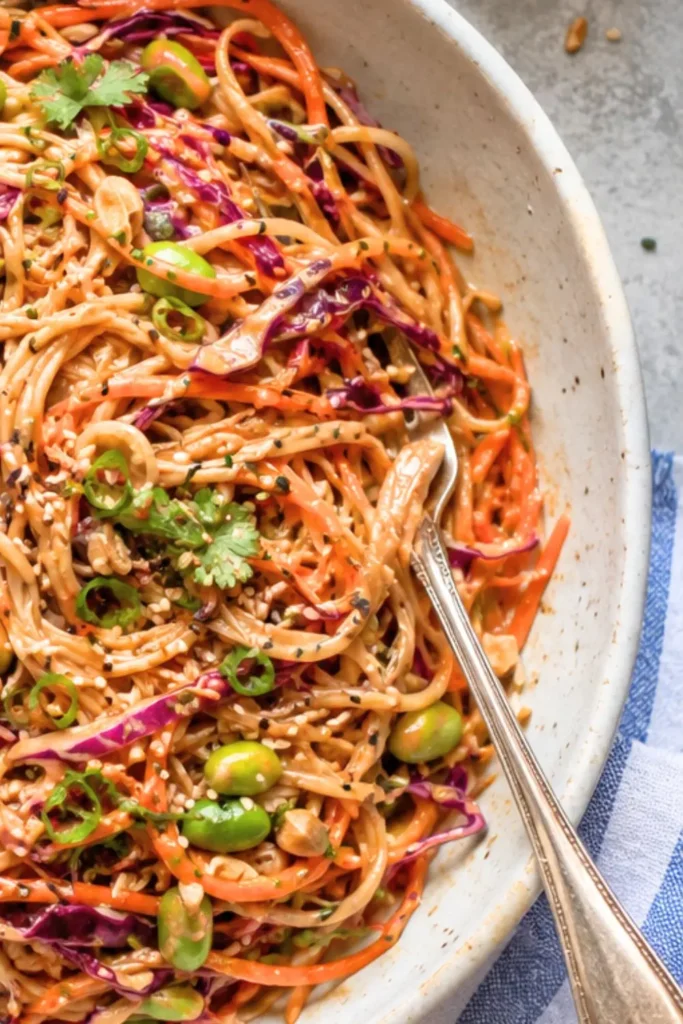
The recipe specifically calls for the vegetables to be cut into thin matchsticks rather than rounds, chunks, or shreds. This specific cut serves multiple purposes:
Textural compatibility- Matchstick-cut vegetables have a similar dimension profile to the lo mein noodle strands this means when you take a forkful of noodles, the vegetable pieces come along naturally rather than falling off or being left behind. A chunk would be too large; a round would roll out of the fork.
Crunch retention- Thin matchsticks have a specific crispness-to-size ratio — thin enough to snap cleanly when bitten, substantial enough to maintain that crunch against the soft noodles. Very thin julienne cuts can become limp quickly; thick chunks are too hard.
Sauce distribution- Matchstick surfaces hold sauce along their length, creating seasoned vegetables that contribute flavor to every bite rather than acting as bland filler between noodle portions.
Cutting Technique for Consistent Matchsticks
Bell pepper- Remove stem and seeds. Cut into 3-inch sections, then slice each section into thin strips.
Carrot- Peel, cut into 3-inch sections, slice each section lengthwise into thin planks, then cut each plank into thin strips.
Cucumber- Peel, cut into 3-inch sections, quarter each section lengthwise, remove seed portion if desired, then slice into thin strips.
Consistent thickness matters for even texture aim for approximately ⅛ inch width for all vegetable matchsticks.
Still Hungry, Try It Next recipe
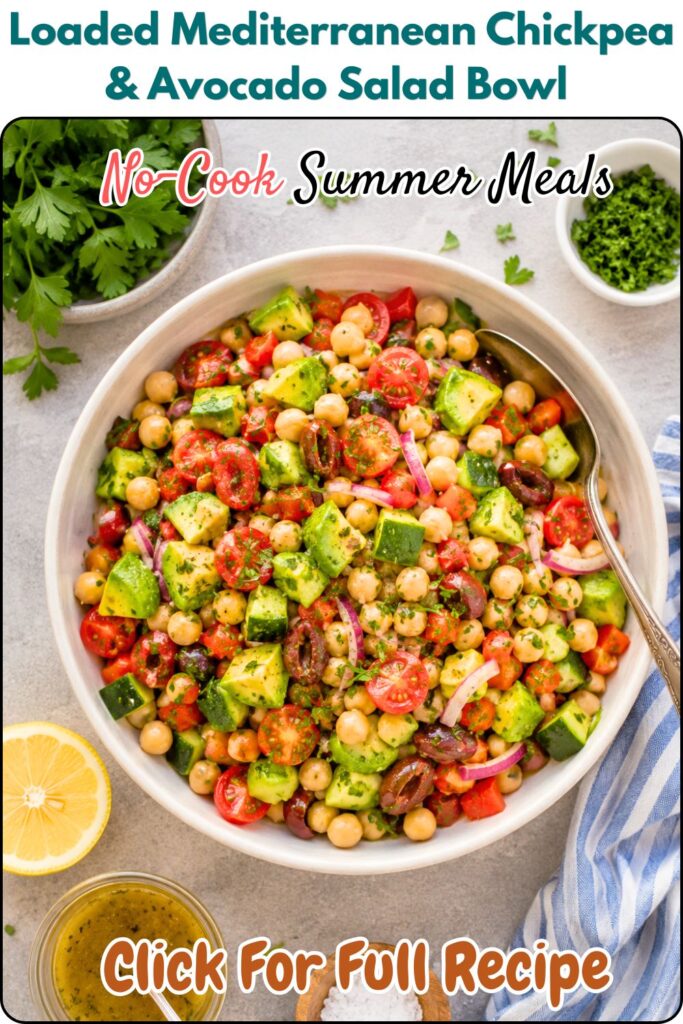
Loaded Mediterranean Chickpea & Avocado Salad Bowl
Step-by-Step Instructions For Cold Sesame Peanut Noodles with Crunchy Veggies
Stage 1 – Noodles (Can Do Night Before)
Cook lo mein noodles according to package directions until al dente firm with some resistance when bitten, not fully soft.
Drain and immediately toss with the 2 tablespoons of sesame oil in a large bowl. Toss thoroughly every noodle strand should be coated. Cover the bowl with plastic wrap or transfer to an airtight container and refrigerate for 1 hour minimum (up to overnight if making ahead).
Stage 2 – Vegetables (During Chill Period)
Cut the scallions, bell pepper, carrot, and cucumber into thin matchsticks as described above. Set aside a few pieces of each vegetable for garnish if desired. Store cut vegetables covered until assembly.
Stage 3 – Make the Sauce
In a medium bowl, whisk together the soy sauce, peanut butter, tahini, rice vinegar, sesame oil, brown sugar, chili garlic sauce, grated ginger, and grated garlic until completely smooth.
The sauce should be thick but pourable similar to a thin BBQ sauce consistency. If it’s too thick to pour easily, add 1-2 tablespoons of warm water and whisk again.
Taste before adding to noodles- The sauce should taste intensely flavored salty, nutty, slightly sweet, and noticeably spicy. It will mellow slightly when distributed across 12 ounces of noodles and the vegetables.
Stage 4 – Assembly
Remove the chilled noodles from the refrigerator. Add the cut vegetables to the noodle bowl. Pour the sauce over everything.
Toss thoroughly – use tongs or two forks to lift and fold the noodles with the sauce and vegetables rather than stirring in circles. Circular stirring tangles the noodles; lifting and folding distributes the sauce more evenly.
Arrange reserved vegetable pieces on top as garnish. Sprinkle with sesame seeds.
Serve immediately – this dish is at its best texture immediately after tossing, while the vegetables are still at peak crispness.
Serving Ideas How to Build Around These Noodles
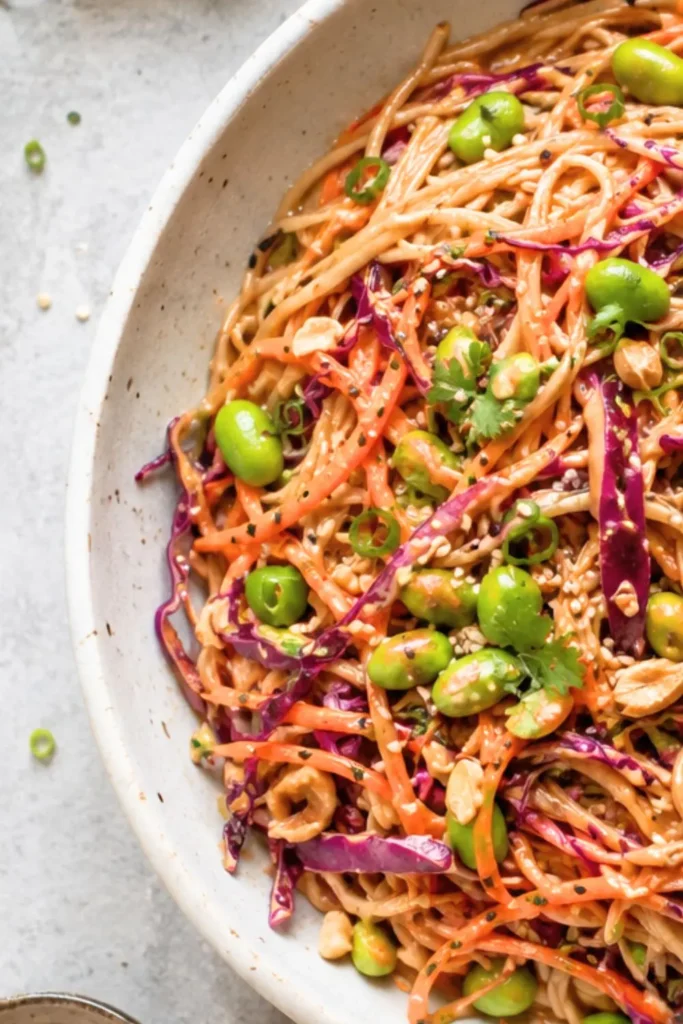
Protein additions:
- Crispy baked tofu cubes (pressed, seasoned, baked at 400°F for 25 minutes) toss in alongside the vegetables
- Shelled edamame adds protein and a beautiful green color contrast
- Marinated tempeh strips
Additional garnishes:
- Crushed peanuts – for more crunch and peanut flavor reinforcement
- Lime wedges – for squeezing over individual servings
- Fresh cilantro – if you’re in the camp that considers cilantro a positive addition
- Sliced fresh chili – for additional heat
Nutrition Information Per Serving
At 512 calories per serving for 4 servings:
| Nutrient | Per Serving |
| Calories | 512 kcal |
| Carbohydrates | 74g |
| Protein | 12g |
| Fat | 19g |
| Fiber | 4g |
| Sodium | 950mg |
| Vitamin A | 3629 IU |
| Vitamin C | 43mg |
| Potassium | 322mg |
3629 IU of Vitamin A per serving approximately 73% of the daily recommended intake primarily from the carrot’s beta-carotene. 43mg of Vitamin C from the red bell pepper. The 950mg of sodium reflects the soy sauce content use low-sodium soy sauce as specified and avoid adding additional salt to keep sodium at this level.
Storage
- Dressed noodles- Refrigerate for up to 3 days the noodles absorb the sauce daily and become more flavorful, though the vegetable crunch diminishes
- Undressed noodles + sauce separately- Store components separately for up to 4 days and dress portions individually for maximum vegetable crispness
- The sauce alone- Refrigerates for up to 1 week a useful make-ahead component
My Final Thoughts
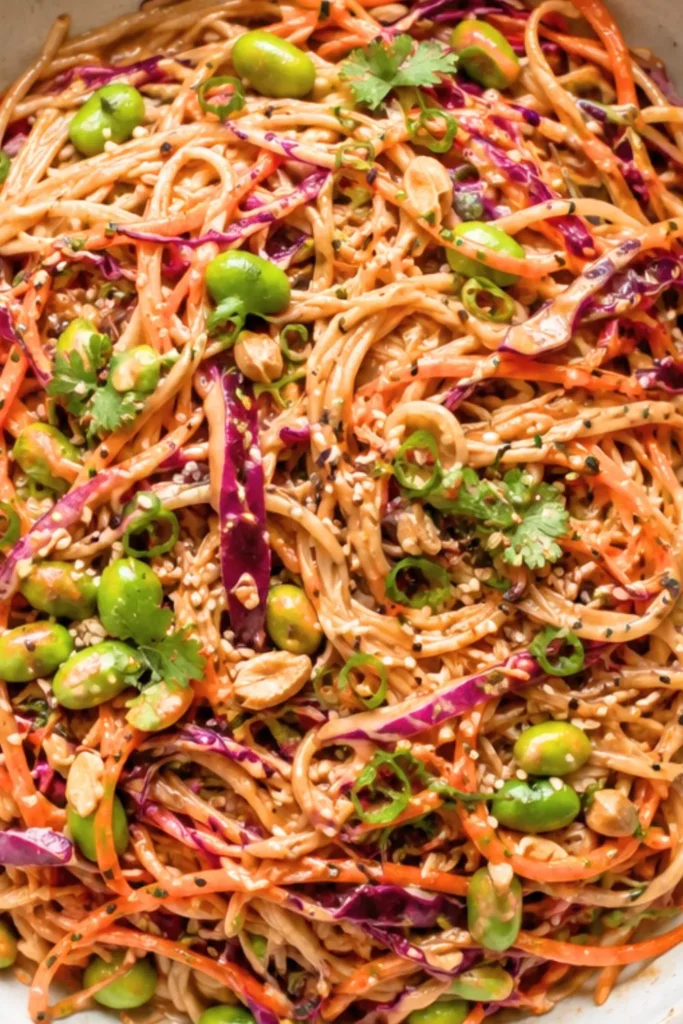
Cold Sesame Peanut Noodles with Crunchy Veggies are the no-cook summer meal (minimal cook) that fills the significant gap between “it’s too hot to cook anything substantial” and “I need actual food.” 512 calories, 12 grams of protein, genuinely complex peanut-sesame sauce, and fresh vegetables that provide the textural contrast the whole dish is built around.
Cook the noodles, toss with sesame oil, refrigerate. Make the sauce while the noodles chill. Cut the vegetables. Toss and serve.
Then eat the cold, saucy, crunchy, genuinely excellent noodles and remember that summer cooking can be this good this easily.
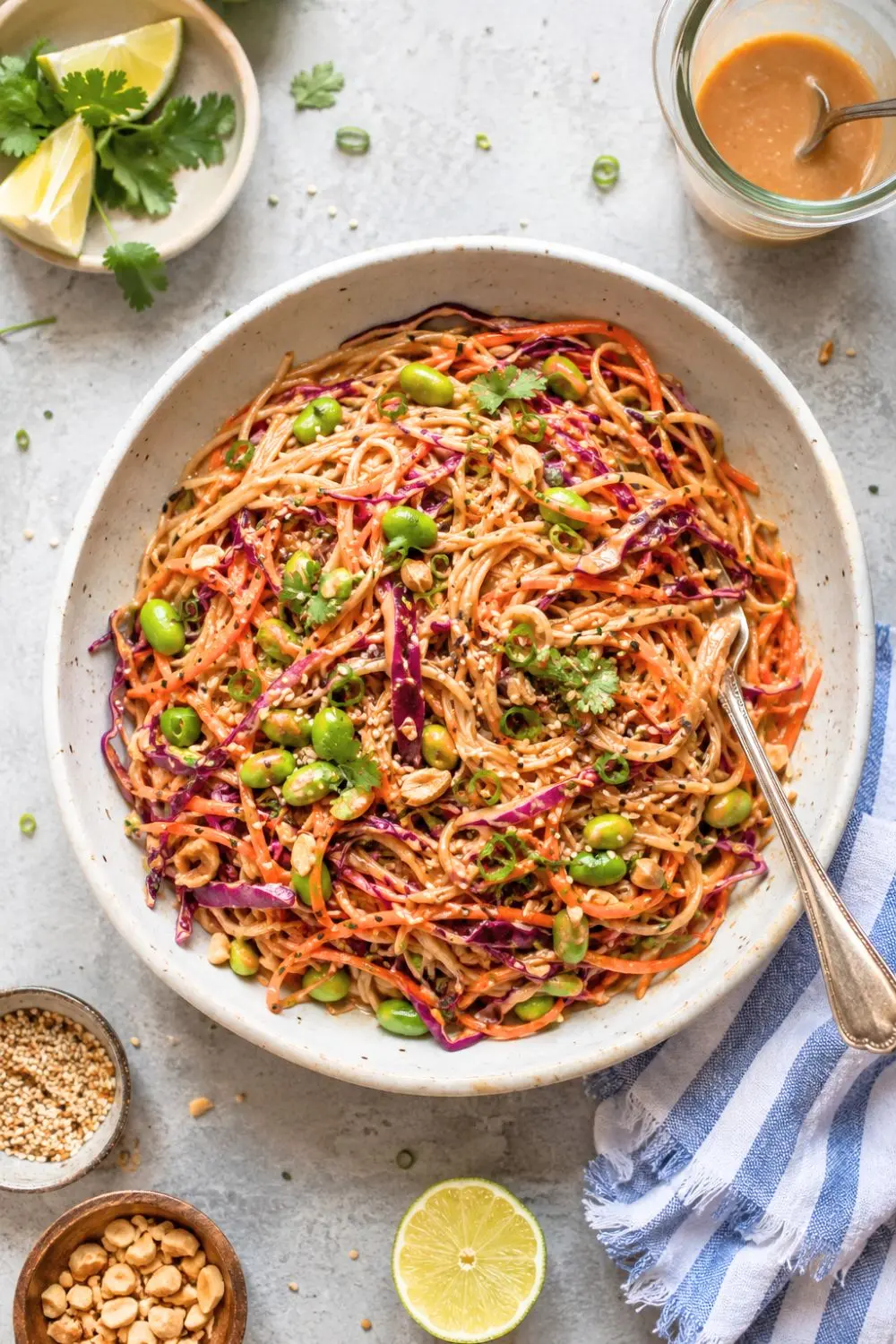
Cold Sesame Peanut Noodles with Crunchy Veggies
Ingredients
Equipment
Method
- Stage 1 – Noodles (Can Do Night Before)
- Cook lo mein noodles according to package directions until al dente firm with some resistance when bitten, not fully soft.
- Drain and immediately toss with the 2 tablespoons of sesame oil in a large bowl. Toss thoroughly every noodle strand should be coated. Cover the bowl with plastic wrap or transfer to an airtight container and refrigerate for 1 hour minimum (up to overnight if making ahead).
- Stage 2 – Vegetables (During Chill Period)
- Cut the scallions, bell pepper, carrot, and cucumber into thin matchsticks as described above. Set aside a few pieces of each vegetable for garnish if desired. Store cut vegetables covered until assembly.
- Stage 3 – Make the Sauce
- In a medium bowl, whisk together the soy sauce, peanut butter, tahini, rice vinegar, sesame oil, brown sugar, chili garlic sauce, grated ginger, and grated garlic until completely smooth.
- The sauce should be thick but pourable similar to a thin BBQ sauce consistency. If it’s too thick to pour easily, add 1-2 tablespoons of warm water and whisk again.
- Taste before adding to noodles- The sauce should taste intensely flavored salty, nutty, slightly sweet, and noticeably spicy. It will mellow slightly when distributed across 12 ounces of noodles and the vegetables.
- Stage 4 – Assembly
- Remove the chilled noodles from the refrigerator. Add the cut vegetables to the noodle bowl. Pour the sauce over everything.
- Toss thoroughly – use tongs or two forks to lift and fold the noodles with the sauce and vegetables rather than stirring in circles. Circular stirring tangles the noodles; lifting and folding distributes the sauce more evenly.
- Arrange reserved vegetable pieces on top as garnish. Sprinkle with sesame seeds.
- Serve immediately – this dish is at its best texture immediately after tossing, while the vegetables are still at peak crispness.
Notes
Nutrition Information Per Serving
At 512 calories per serving for 4 servings:| Nutrient | Per Serving |
| Calories | 512 kcal |
| Carbohydrates | 74g |
| Protein | 12g |
| Fat | 19g |
| Fiber | 4g |
| Sodium | 950mg |
| Vitamin A | 3629 IU |
| Vitamin C | 43mg |
| Potassium | 322mg |

Hi — I’m Rachel. I’m a wife, a mom, and a home cook who believes that food should bring comfort, joy, and compassion to the table. I live with my family — two hungry little foodies who are my most honest recipe testers — and together we’ve built a kitchen culture that’s all about good food that happens to be 100% vegan. I started this blog because I wanted a place to share the recipes that keep our days moving, the dishes that make weeknights feel a little easier, and the meals that become our little family traditions.